JLPT N5 - Grammar 🌟 より~ほうが yori ~hou ga
Have you ever found yourself in a heated debate with a friend about the most important questions in life?
Like… are cats cuter than dogs? Or is ramen definitely better than pasta?
When you want to compare two things and say that one is “more” than the other, Japanese uses a very handy grammar pattern: より~ほうが (yori ~hou ga).
Whether you’re choosing between two travel destinations or simply explaining your preferences, this grammar point is perfect for expressing comparisons clearly and naturally.
Let’s learn how to use it and start comparing like a pro!
Ready? Let's go!


ほうがいい (hou ga ii) vs より~ほうが (yori ~hou ga)
Both expressions use ほうが, so they look similar at first, but their meaning and purpose are completely different.
ほうがいい (hou ga ii)
This expression is used to give advice or suggestions.
It means “it’s better to do something” or “you should do something.”
薬を飲んだほうがいいです。
くすり を のんだ ほうが いい です。
kusuri wo nonda hou ga ii desu.
You should take some medicine.
より~ほうが (yori ~hou ga)
This pattern is used to compare two things and say which one has more of a quality.
りんごよりオレンジのほうが好きです。
りんご より おれんじ の ほうが すき です。
ringo yori orenji no hou ga suki desu.
I like oranges more than apples.
Use より~ほうが when you are comparing A and B.
Word Order Flexibility with より~ほうが (yori ~hou ga)
One nice feature of より~ほうが is that the word order is flexible.
You can say:
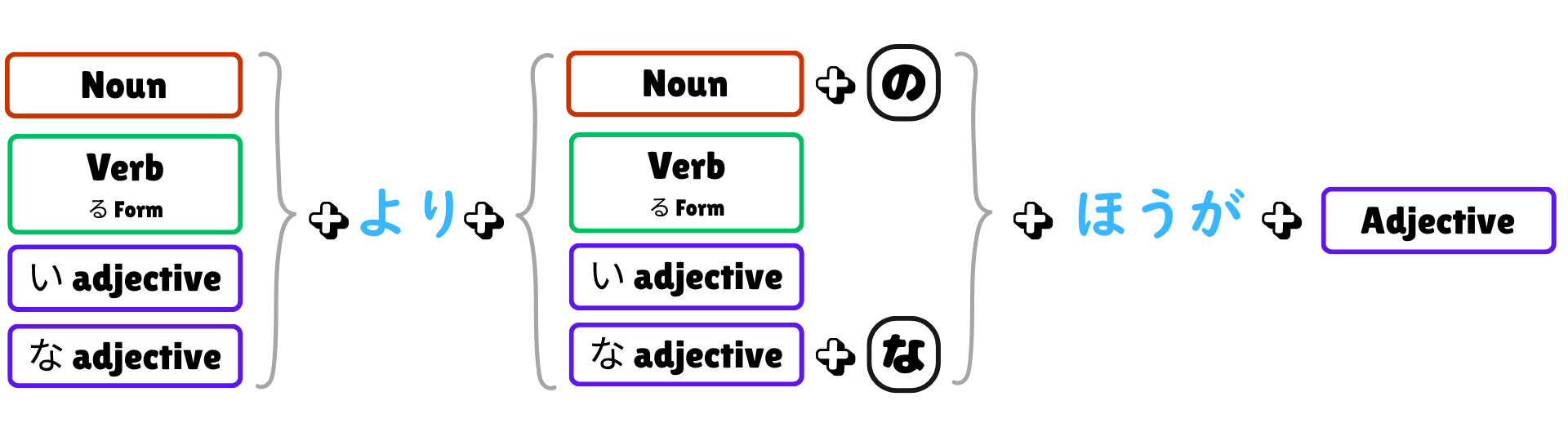
[ A ] + より+ [ B ]+ほうが … or [ B ]+ほうが + [ A ] + より…
Both mean the same thing.
Just remember! The item marked with ほうが is always the “more” side.

ねこより犬のほうが好きです。
ねこ より いぬ の ほう が すき です。
neko yori inu no hou ga suki desu.
I like dogs more than cats.
バスより電車のほうがはやいです。
ばす より でんしゃ の ほう が はやい です。
basu yori densha no hou ga hayai desu.
Trains are faster than buses.
それよりこれのほうが かわいいです。
それ より これ の ほう が かわいい です。
sore yori kore no hou ga kawaii desu.
This one is cuter than that one.
月曜日より金曜日のほうが楽しいです。
げつようび より きんようび の ほう が たのしい です。
getsuyoubi yori kinyoubi no hou ga tanoshii desu.
Fridays are more fun than Mondays.
部屋は、せまいより広いほうがいいです。
へや は、せまい より ひろい ほう が いい です。
heya ha, semai yori hiroi hou ga ii desu.
A room is better if it’s spacious rather than small.
うるさいよりしずかなほうが集中できます。
うるさい より しずかな ほう が しゅうちゅう できます。
urusai yori shizukana hou ga shuuchuu dekimasu.
I can concentrate better when it’s quiet rather than noisy.
料理は、作るより食べるほうが幸せです。
りょうり は つくる より たべる ほう が しあわせ です。
ryouri ha tsukuru yori taberu hou ga shiawase desu.
When it comes to cooking, eating makes me happier than cooking.
日本語は、書くより話すほうがとくいです。
にほんご は、かく より はなす ほう が とくい です。
nihongo ha, kaku yori hanasu hou ga tokui desu.
With Japanese, I’m better at speaking than writing.
田中さんより林さんのほうがよく働きます。
たなかさんよりはやしさんのほうがよくはたらきます。
Tanaka-san yori Hayashi-san no hou ga yoku hataraki masu.
Hayashi-san works more than Tanaka-san.

- Grammar Point: より~ほうが (yori ~hou ga)
- JLPT Level: N5
- Meaning: B is more [adjective] than A
- Quick Explanation: Use this pattern to compare two things. より shows what you are comparing against, and のほうが shows which one is “more.”
So that’s how we use より~ほうが!
It’s a simple but powerful way to share opinions and compare the world around you.
あなたの日本語は、昨日より今日のほうが上手になっているよ!
あなた の にほんご は、きのう より きょう の ほう が じょうず に なって いる よ!
anata no nihongo ha, kinou yori kyou no hou ga jouzu ni natte iru yo!
Your Japanese is better today than it was yesterday!
Little comparisons like this help you notice your progress.
Keep practicing, and using Japanese will feel more and more natural.
Now it’s your turn! Try comparing two things you like using より~ほうが.
Your Sensei,
Hikari 👩🏻🏫✨
Get Hikari's JLPT Mock Exams & Preparation Lessons!
Whether you are studying to pass the JLPT or looking for a challenge in your learning journey, these courses are perfect for you!
Join my ニュースレター Newsletter 📩
You can expect an email from me once a week about Japanese culture.
Don't worry, your information will not be shared.
We hate SPAM. We will never sell your information, for any reason.