JLPT N5 - Grammar 🌟 があります ga arimasu

You’re walking down a street in Japan for the first time, everything feels new and exciting!
You spot a bright sign and gasp,
“Oh! There’s a konbini (convenience store)!”
You walk in and look around
“There’s an onigiri corner! There’s a sandwich corner! …Wait, there it is! My dream tamago sando! ”
In moments like this, you’re describing what exists around you, what is there.
In Japanese, we use があります (ga arimasu) to say “there is” or “there are.”
But that’s not all! It can also mean “I have” when talking about things you own, time, or plans.
It’s an N5-level grammar point, super useful for talking about things, places, or events that exist.
Let’s learn how to use があります naturally so you can describe your discoveries in Japan just like a local!


To describe where something is
Use this simple pattern:
Place + に + Thing + が + あります
“There is (a thing) in/at (a place).”
For example:
コンビニ に たまごサンド が あります。
こんびに に たまご さんど が あります。
konbini ni tamago sando ga arimasu.
There is an egg sandwich at the convenience store.
This pattern is super useful when you’re exploring Japan and want to describe what you see around you, like shops, signs, or even your favorite ramen spot.
がいます(ga imasu) vs があります(ga arimasu)
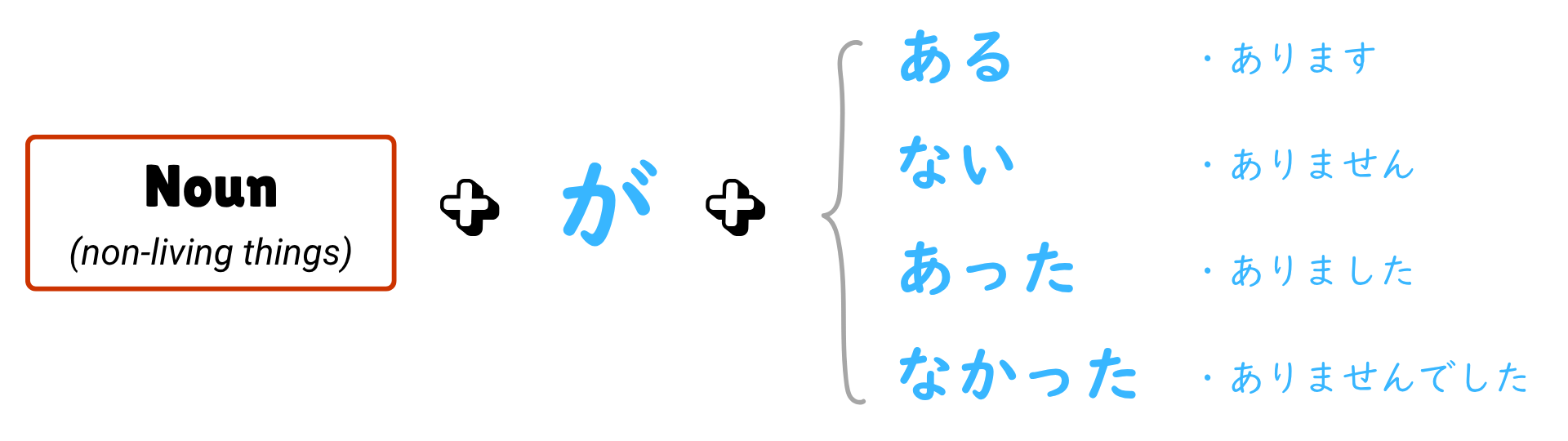
Both がいます and があります mean “there is” or “there are,” but they’re used for different kinds of things.
がいます is used for living things : people, animals, or anything that moves or breathes.
がありますis used for non-living things : objects, places, ideas, or events.
For example:
先生がいます。
せんせい が います。
sensei ga imasu.
There is a teacher.
テレビ が あります。
てれび が あります。
terebi ga arimasu.
There is a TV.


公園に桜があります。
こうえん に さくら が あります。
kouen ni sakura ga arimasu.
There are cherry blossom trees in the park.
銀行に用事があります。
ぎんこう に ようじ が あります。
ginkou ni youji ga arimasu.
I have something to do at the bank.
より道する時間がありません。
よりみち する じかん が ありません。
yorimichi suru jikan ga arimasen.
I don’t have time to make a stop on the way.
この図書館はWi-Fiがない。
この としょかん は わいふぁい が ない。
kono toshokan ha waifai ga nai.
This library doesn’t have Wi-Fi.
家の近くに猫カフェがありました。
いえ の ちかく に ねこかふぇ が ありました。
ie no chikaku ni nekokafe ga arimashita.
There was a cat cafe near my house.
レストランに行くお金がなかった。
れすとらん に いく おかね が なかった。
resutoran ni iku okane ga nakatta.
I didn’t have money to go to the restaurant.

- Grammar Point: があります (ga arimasu)
- JLPT Level: N5
- Meaning: There is, there are, to have (for non-living things)
- Quick Explanation: Use 〜があります to talk about the existence of non-living things, places, events, or ideas.
It can also mean “I have” when referring to something you possess, like money, time, or plans.
So that’s how we use があります!
It’s one of the most basic, and most useful, grammar patterns in Japanese.
With this one phrase, you can describe what you see around you and what you have in your life.
いま、あなたの周りには、何がありますか?スマホ?テーブル?コーヒーカップ?本棚?
いま、あなた の まわり に は、なに が あります か? すまほ? てーぶる? こーひーかっぷ?ほんだな?
ima, anata no mawari ni ha, nani ga arimasu ka? sumaho? teeburu? koohii kappu? hon dana?
What do you have around you right now? Your smartphone? A table? A coffee cup? A bookshelf?
Now it’s your turn! try making your own sentences with があります and describe the things you can see around you!
Your Sensei,
Hikari 👩🏻🏫
Get Hikari's JLPT Mock Exams & Preparation Lessons!
Whether you are studying to pass the JLPT or looking for a challenge in your learning journey, these courses are perfect for you!
Join my ニュースレター Newsletter 📩
You can expect an email from me once a week about Japanese culture.
Don't worry, your information will not be shared.
We hate SPAM. We will never sell your information, for any reason.