JLPT N5 - Grammar 🌟 だ / です da / desu

Alright everyone, today’s grammar is one of the absolute basics!
We’re talking about だ/です (da / desu), the small but mighty words that mean “to be” (am, is, are) in Japanese.
You’ll hear です all the time, it’s the sentence-ending marker that pops up everywhere!
From self-introductions to giving opinions or describing things, this grammar point is truly the foundation of Japanese conversation.
Whether you say “I’m a student,” “This is coffee,” or “Japan is beautiful,”
you’re already using だ / です!
So, let’s dive in and learn how to sound polite with です, or casual and natural with だ.
Ready to go? Let’s start!


💡Politeness Tip
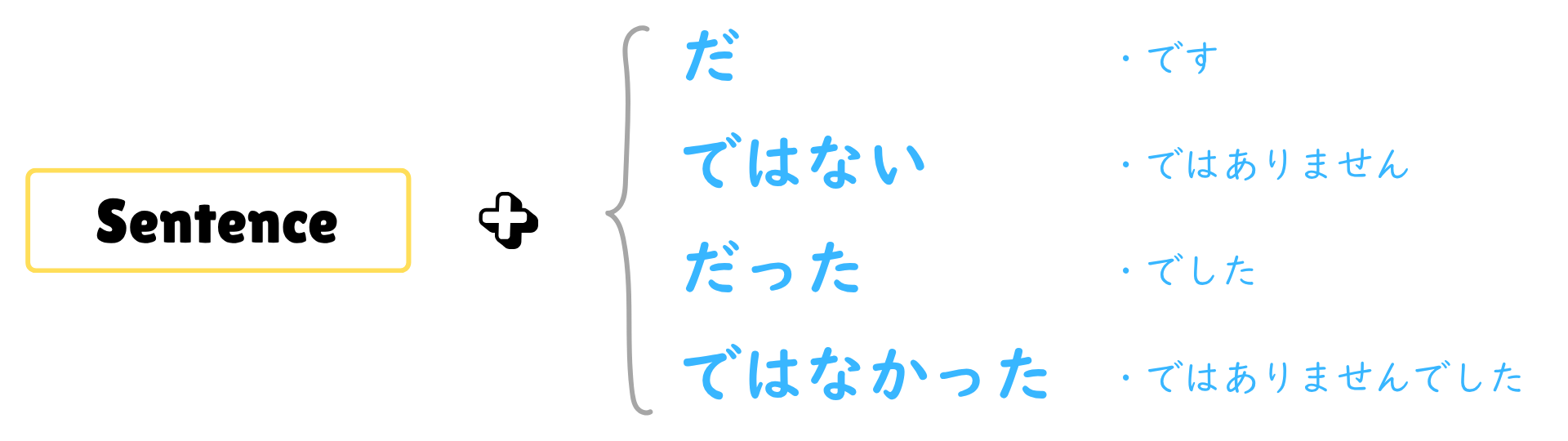
Both だ / です and their negative forms mean “to be” or “not to be”, but the difference is all about formality and tone!
Polite & safe: です desu (positive) / ではありません de ha arimasen (negative)
Casual & friendly : だ da (positive) / じゃない janai (negative)
More common in daily conversation than ではない deha nai : じゃない janai (negative)
And here’s a little secret:
If you’re not sure which one to use the formal versions, it’s always the safest choice, you’ll sound polite, natural, and never rude.

私は ひかりです。
わたし は ひかり です。
watashi ha hikari desu.
I’m Hikari.
私は 日本語の 先生です。
わたし は にほんご の せんせい です。
watashi ha nihongo no sensei desu.
I’m a Japanese teacher.
今日は 金曜日…じゃない、まだ 木曜日だ!
きょう は きんようび…じゃない、まだ もくようび だ!
kyou ha kinyoubi... janai, mada mokuyoubi da!
Today is Friday… wait, no, it’s still Thursday!
昨日の ホームパーティーは 楽しかったです。
きのう の ほーむぱーてぃー は たのしかった です。
kinou no ho-mupa-ti- ha tanoshikatta desu.
The home party yesterday was fun.
この 俳優は 日本では 有名ではない。
この はいゆう は にほん では ゆうめい では ない。
kono haiyuu ha nihon deha yuumei deha nai.
This actor isn’t famous in Japan.
祖父は 若い頃、 お酒が 大好きでした。
そふ は わかい ころ、おさけ が だいすき でした。
sofu ha wakai koro, osake ga daisuki deshita.
My grandfather loved alcohol when he was young.

- Grammar Point: だ / です (da / desu)
- JLPT Level: N5
- Meaning: To be (am, is, are)
- Quick Explanation: だ/です is one of the most basic and important grammar points in Japanese.
It’s used to describe or identify something, just like “to be” in English.
So that’s how we use だ / です!
It may look simple, but it’s the foundation of almost every Japanese sentence.
私は日本人です。
わたしは にほんじん です。
watashi ha nihonjin desu.
I am Japanese.
Now it’s your turn! try making your own sentences using だ/です, and practice saying them out loud like a natural!
Your Sensei,
Hikari 👩🏻🏫
Get Hikari's JLPT Mock Exams & Preparation Lessons!
Whether you are studying to pass the JLPT or looking for a challenge in your learning journey, these courses are perfect for you!
Join my ニュースレター Newsletter 📩
You can expect an email from me once a week about Japanese culture.
Don't worry, your information will not be shared.
We hate SPAM. We will never sell your information, for any reason.