JLPT N4 - Grammar 🌟 ~みたい ~mitai

Have you ever wanted to say “looks like” or “seems like” in Japanese?
For example: “Her smile is like the sun” or “It seems like he’s feeling down because work isn’t going well.”
This expression is also super useful when you forget or don’t know the exact word.
For example: “Um… It’s like an apple: red outside and yellow inside, but smaller and softer. What was it?”
Actually, even when I speak English, if I can’t remember the right word quickly, I always end up saying, “Something is like…” (I use it all the time!).
In Japanese, we often use 〜みたい for this.
In this article, we’ll explore how to use みたい in different ways: みたいです, みたいな, and みたいに.


1. みたい (mitai) vs ようだ (youda)
- みたい (mitai) → casual, spoken, everyday use
- ようだ (youda) → formal, used in writing, reports, and polite speech
- 彼は学生みたい。kare ha gakusei mitai. (He looks like a student. : casual)
- 彼は学生のようだ。kare ha gakusei no youda. (He seems like a student. : formal)
💡 Tip: みたい (mitai) is casual, and ようだ (youda) is more formal. Use them depending on the situation.
2. みたい (mitai) vs らしい (rashii)
- みたい (mitai) → based on what you see or feel
- らしい (rashii) → based on hearsay or information from others
- 彼は日本語を話せるみたい。kare ha nihongo wo hanaseru mitai. (It looks like he can speak Japanese. : judging from appearance or situation)
- 彼は日本語を話せるらしい。kare ha nihongo wo hanaseru rashii. (I heard he can speak Japanese. : reported information)
💡 Tip: Both express a kind of assumption, but らしい (rashii) has a nuance of hearsay, information you got from someone else rather than from your own direct observation.
3. 〜みたい (~mitai) vs 見たい (mitai)
There’s another word that sounds the same: 見たい (mitai) = want to see.
This is totally different from 〜みたい (like/seems like).
💡 Tip: The “like/seems like” 〜みたい is always written in hiragana. The “want to see” 見たい often uses kanji for 見.


彼女のえがおは、太陽みたい。
かのじょのえがおは、たいようみたい。
kanojo no egao ha, taiyou mitai
Her smile is like the sun.
あの犬、ライオンみたいだね!
あのいぬ、らいおんみたいだね!
ano inu, raion mitai da ne!
That dog looks like a lion!
道が混んでいるみたいです。
みちがこんでるみたいです。
michi ga konde iru mitai desu
It seems like the road is crowded.
この映画は面白いみたいですね。
このえいがはおもしろいみたいですね。
kono eiga ha omoshiroi mitai desu ne.
This movie looks interesting.
このレストランは有名みたいです。
このれすとらんはゆうめいみたいです。
kono resutoran ha yuumei mitai desu.
This restaurant looks famous.
彼、仕事がうまくいってなくて落ち込んでいるみたい。
かれ、しごとがうまくいってなくておちこんでいるみたい。
kare, shigoto ga umaku ittenakute ochikonde iru mitai.
It seems like he’s feeling down because work isn’t going well.
みてみて!ドラゴンボールの神龍みたいな雲がある!
みてみて!どらごんぼーるのしぇんろんみたいなくもがある!
mite mite! doragon booru no shenron mitai na kumo ga aru
Look, look! There’s a cloud that looks like Shenron from Dragon Ball!
彼がきているみたいなTシャツがほしい。
かれがきているみたいなTしゃつがほしい。
kare ga kiteiru mitai na T-shatsu ga hoshii
I want a T-shirt like the one he’s wearing.
あの...りんごみたいに赤くて中が黄色いけど、もっと小さくてやわらかいフルーツ...なんだっけ?
あの...りんごみたいにあかくてなかがきいろいけど、もっとちいさくてやわらかいふるーつ...なんだっけ?
ano…ringo mitai ni akakute nakaga kiiroi kedo, motto chiisakute yawarakai furuutsu…nann dakke?
Um… It’s like an apple, red outside and yellow inside—but smaller and softer. What was it?
彼女は走っているみたいに歩く。
かのじょははしっているみたいにあるく。
kanojo ha hashitte iru mitai ni aruku
She walks as if she’s running.
日本に来れたのがうれしすぎて、子どもみたいにはしゃいでいます。
にほんにこれたのがうれしすぎて、こどもみたいにはしゃいでいます。
nihon ni koreta no ga ureshisugite, kodomo mitai ni hashaide imasu
I’m so happy to be in Japan that I’m jumping around like a child.
上司の部屋はジャングルみたいにあれている。
じょうしのへやはじゃんぐるみたいにあれている。
joushi no heya ha janguru mitai ni arete iru
My boss’s room is as messy as a jungle.
彼女は歌っているみたいに話す。
かのじょはうたっているみたいにはなす。
kanojo ha utatte iru mitai ni hanasu
She talks as if she is singing.
彼女はモデルみたいにきれいですね。
かのじょはもでるみたいにきれいですね。
kanojo ha moderu mitai ni kirei desune.
She is beautiful like a model.
彼は子供みたいに元気だ。
かれはこどもみたいにげんきだ。
kare ha kodomo mitai ni genki da.
He is energetic like a child.

- Grammar Point: 〜みたい(mitai)
- JLPT Level: N4
- Meaning: like, similar to, resembling, seems like
- Quick Explanation: Used to describe similarity in appearance, feeling, or situation.
It can also express assumptions based on what you see or hear.
Key Forms:
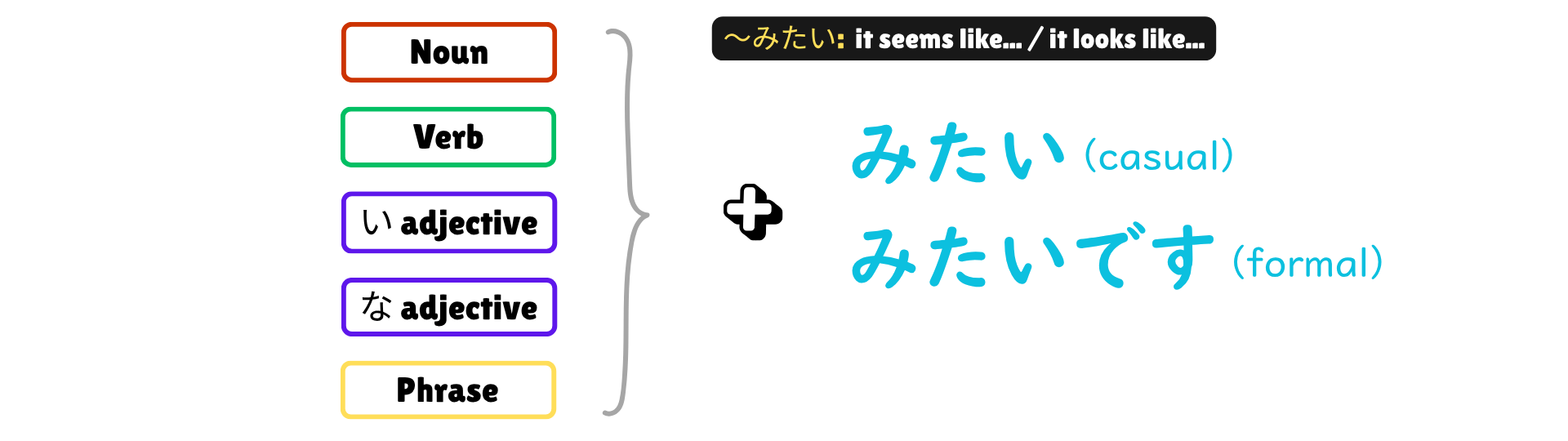
みたい / みたいです → at the end of a sentence (It seems / looks like…)
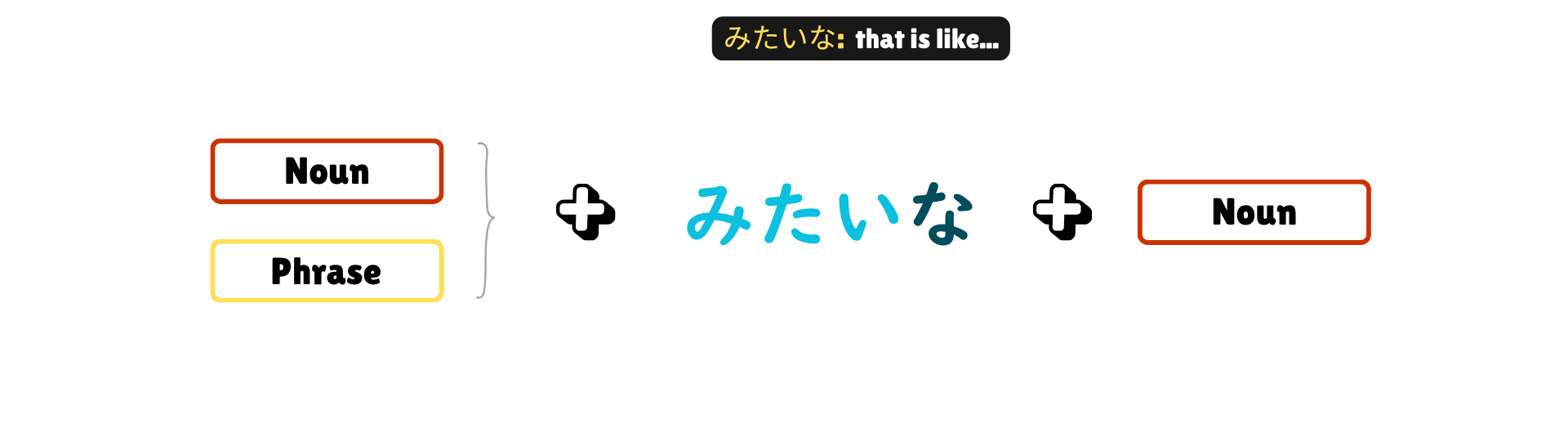
みたいな + noun → modifies a noun (A thing like…)
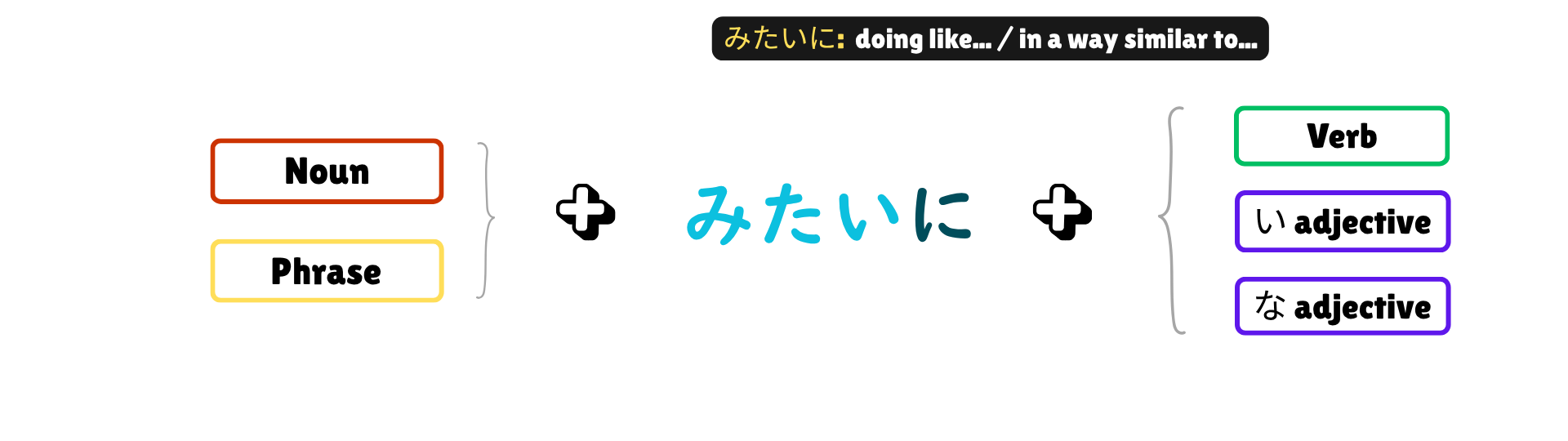
みたいに + verb/adjective → modifies a verb/adjective (Do something like…)
So that’s how we use 〜みたい in Japanese!
It’s super flexible: you can use it at the end of a sentence (みたい / みたいです), before a noun (みたいな), or before a verb/adjective (みたいに).
Just remember: it’s always written in hiragana, and don’t confuse it with 見たい (want to see).
Now it’s your turn! Try making your own Japanese sentence using 〜みたい.
Your Sensei,
Hikari 👩🏻🏫
Get Hikari's JLPT Mock Exams & Preparation Lessons!
Whether you are studying to pass the JLPT or looking for a challenge in your learning journey, these courses are perfect for you!
Join my ニュースレター Newsletter 📩
You can expect an email from me once a week about Japanese culture.
Don't worry, your information will not be shared.
We hate SPAM. We will never sell your information, for any reason.