JLPT N4 - Grammar 🌟 がる / がっている garu / gatteiru
Imagine this, you’re walking down a street in Japan, and suddenly you stop in front of a cake shop.
Your friend’s eyes start sparkling, their mouth drops open, and they can’t look away from the strawberry shortcake in the window…
You can feel it, right?
They really want to eat that cake!
In Japanese, there’s a special way to describe this kind of situation, when someone’s feelings show through their actions or expressions, even if they don’t say a word.
That’s where がる / がっている (garu / gatteiru) comes in!
It’s used when someone else shows signs of emotion, like fear, embarrassment, or desire.
Now, let’s explore it together!


そうだ (souda / seems like) vs がる / がっている(garu / gatteiru)
Both expressions describe how someone appears to feel, but there’s a subtle difference in where the observation comes from.
そうだ focuses on appearance, what you see or sense from the outside.
It’s like saying, “They look happy” or “She seems tired.”
It’s your impression based on what you can observe.
がる / がっている, on the other hand, focuses on behavior, what the person does that shows their feeling.
It’s not just how they look, but how they act or react emotionally.
Examples:
彼はうれしそうだ。
かれ は うれしそうだ。
kare ha ureshisou da.
He looks happy. (based on appearance)
彼はうれしがっている。
かれ は うれしがっている。
kare ha ureshigatteiru.
He’s showing happiness. (based on action or reaction)
Common Usage Pattern: ほしがる (hoshigaru) : “to want”
When describing someone else’s desire, we use ほしがる (hoshigaru).
This combines ほしい + がる to express a stronger, more visible feeling, when someone clearly shows that they want something.
Example:
彼女は新しいアクセサリーをほしがっている。
かのじょ は あたらしい あくせさりー を ほしがっている。
kanojo ha atarashii akusesarii wo hoshigatteiru.
She wants a new accessory.
You’ll often hear this pattern in daily life, it’s a natural way to describe what someone seems to want, not what you want!
💡 Tip:
ほしがる is never used for your own desires.
To express your wants, use ほしい (hoshii) instead.
✅ 私は新しいアクセサリーがほしい。(I want a new accessory.)
❌ 私は新しいアクセサリーをほしがっている。(unnatural)

うちの猫は爪切られるのをとても嫌がる。
うち の ねこ は つめ きられる の を とても いやがる。
uchi no neko ha tsume kirareru no wo totemo iyagaru.
My cat really hates having its claws trimmed.
子どもが鏡をみて不思議がっている。
こども が かがみ を みて ふしぎ がっている。
kodomo ga kagami wo mite fushigi gatteiru.
The child is looking at the mirror curiously.
彼は試合に負けて、とても悔しがった。
かれ は しあい に まけて、とても くやし がった。
kare ha shiai ni makete, totemo kuyashigatta.
He lost the match and looked very frustrated.
彼は階段から落ちたが、痛がる様子もなかった。
かれ は かいだん から おちた が、いたがる ようす も なかった。
kare ha kaidan kara ochita ga, itagaru yousu mo nakatta.
He fell down the stairs, but didn’t seem to show any sign of pain.
急用で友達は旅行に行けなくて、とても残念がった。
きゅうよう で ともだち は りょこう に いけなくて、とても ざんねん がった。
kyuuyou de tomodachi ha ryokou ni ikenakute, totemo zannen gatta.
My friend couldn’t go on the trip because of an urgent matter and felt very disappointed.
怖がらないで、大丈夫!
こわがらないで、だいじょうぶ!
kowagaranai de, daijoubu!
Don’t be scared, it’s okay!

- Grammar Point: がる / がっている (garu / gatteiru)
- JLPT Level: N4
- Meaning: To show signs of, to appear to feel, to act (a certain emotion)
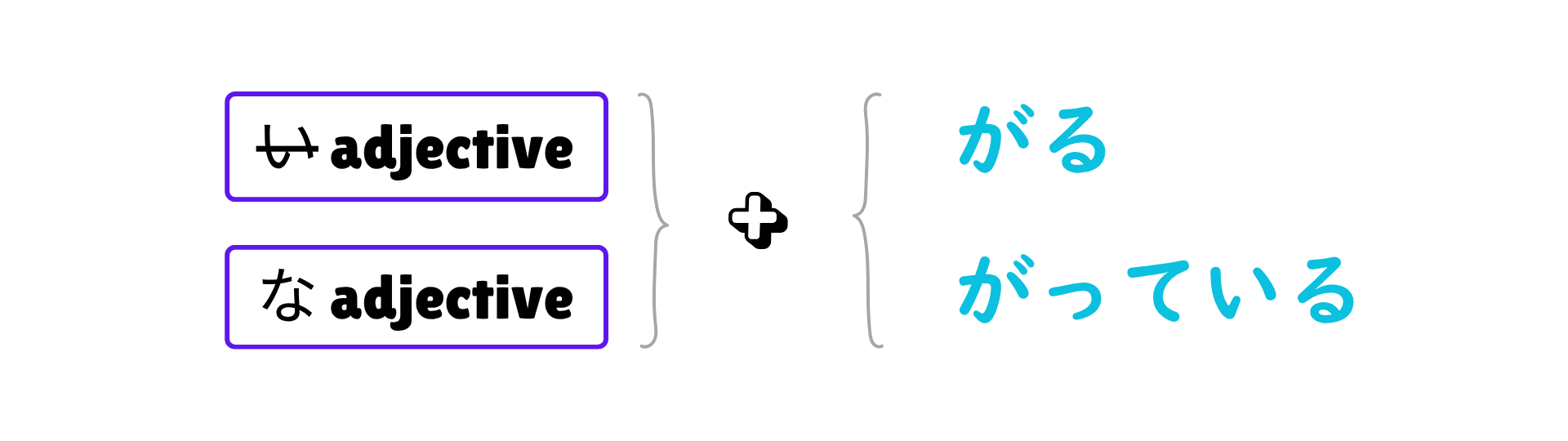
- Quick Explanation: Attach がる to the stem of adjectives that express feelings or desires to describe someone else’s emotions or behavior.
So that’s how we use がる and がっている!
They’re super useful when you want to describe someone’s emotions, like when your friend acts shy, looks scared, or seems really happy.
Once you master this pattern, your Japanese will sound much more expressive, like you can truly capture how people feel around you.
私は、日本のことをたくさん学びたがっているみんなの味方です!
わたし は、にほん の こと を たくさん まなびたがっている みんな の みかた です!
watashi ha, nihon no koto wo takusan manabitagatteiru minna no mikata desu!
I’m on the side of everyone who’s eager to learn all about Japan!
Now it’s your turn! Look around today and try describing how people seem to feel in Japanese!
Your Sensei,
Hikari 👩🏻🏫
Get Hikari's JLPT Mock Exams & Preparation Lessons!
Whether you are studying to pass the JLPT or looking for a challenge in your learning journey, these courses are perfect for you!
Join my ニュースレター Newsletter 📩
You can expect an email from me once a week about Japanese culture.
Don't worry, your information will not be shared.
We hate SPAM. We will never sell your information, for any reason.