JLPT N4 - Grammar 🌟 がり gari

Have you ever noticed that some people always react strongly to certain things?
Like someone who immediately shivers the moment the AC turns on…
or a friend who refuses to watch horror movies because even the trailer is too scary…
or that person who feels lonely the second they’re left alone at a cafe..
If you’ve met people like that (or if that’s you), Japanese has a super handy way to describe this type of “tendency” or “sensitivity.”
がり (gari) !
This little ending is used to describe personality traits or natural tendencies. Things someone often feels or is sensitive to.
It’s perfect for expressing ideas like…
“a person who gets cold easily”
“someone who tends to get embarrassed”
“a naturally lonely type”
And you’ve definitely heard these before in daily Japanese!
Are you ready? Let’s check it out!


がる (garu) vs がり (gari)
These two forms look similar, but they express very different things.
がる (garu)
がる is used when describing someone’s current, observable reaction or emotion.
It describes what you can notice in the moment.
子供がおばけを怖がる。
こどもがおばけをこわがる。
Kodomo ga obake o kowagaru.
Children are afraid of ghosts.
がり (gari)
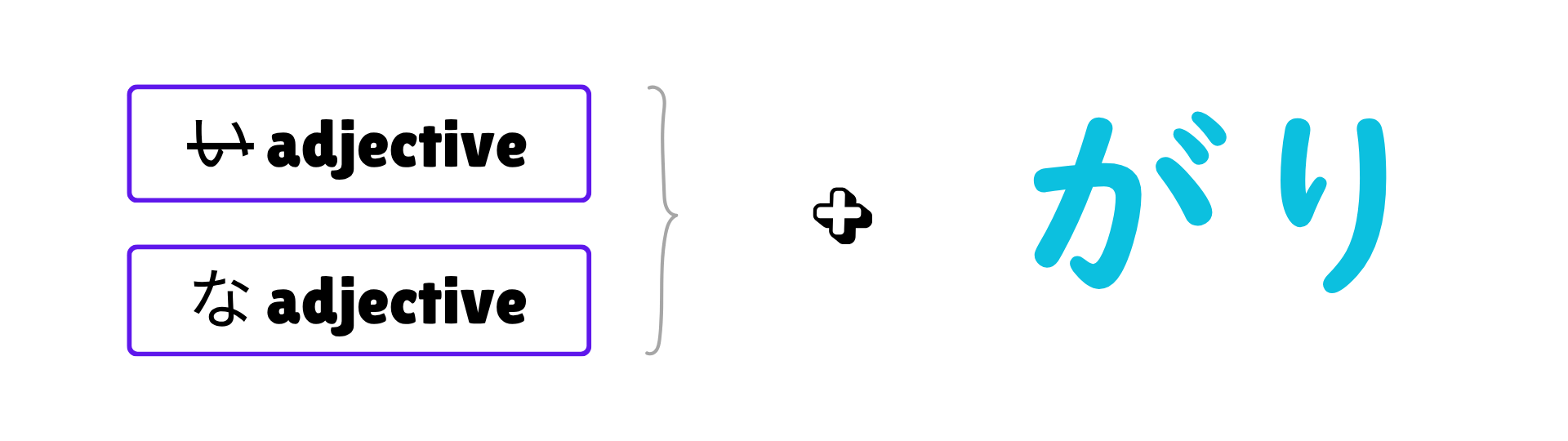
On the other hand, がり describes a personality trait or tendency, how someone usually reacts or what they’re sensitive to in general.
私の犬は寒がりです。
わたし の いぬ は さむがり です。
watashi no inu ha samugari desu.
My dog is sensitive to the cold.


私の妹は怖がりで、ホラー映画が苦手です。
わたし の いもうと は こわがり で、ほらー えいが が にがて です。
watashi no imouto ha kowagari de, horaa eiga ga nigate desu.
My younger sister is easily scared and not good with horror movies.
お父さんは暑がりだから、エアコンを強くします。
おとうさん は あつがり だから、えあこん を つよく します。
otousan ha atsugari dakara, eakon wo tsuyoku shimasu.
My father gets hot easily, so he sets the air conditioner very strong.
私は面倒くさがり屋です。
わたし は めんどうくさがりや です。
watashi ha mendoukusagariya desu.
I’m the kind of person who avoids hassle / I get lazy easily.
私の猫は甘えん坊で、寂しがりです。
わたし の ねこ は あまえんぼう で、さびしがり です。
watashi no neko ha amaenbou de, sabishigari desu.
My cat loves attention and gets lonely easily.
彼女は強がりで、辛いことがあっても大丈夫なふりをする。
かのじょ は つよがり で、つらい こと が あっても だいじょうぶ な ふり を する。
kanojo ha tsuyogari de, tsurai koto ga attemo daijoubu na furi wo suru.
She acts tough and pretends to be fine even when things are hard.

- Grammar Point: がり (gari)
- JLPT Level: N4
- Meaning: A personality trait or sensitivity “tends to,” “is sensitive to,” “is the type who…”
- Quick Explanation: がり attaches to the stem of certain adjectives to describe someone’s usual tendencies, like being sensitive to cold, easily scared, or naturally shy.
So that’s how we use がり!
It’s a super useful pattern for talking about your own tendencies or understanding someone else’s personality in a natural, friendly way.
私の家族はみんな、寒がりです。
わたしのかぞくはみんな、さむがりです。
Watashi no kazoku wa minna, samugari desu.
Everyone in my family is sensitive to the cold.
Now it’s your turn! Make your own sentences to describe your personality or someone you know!
Your Sensei,
Hikari 👩🏻🏫✨
Get Hikari's JLPT Mock Exams & Preparation Lessons!
Whether you are studying to pass the JLPT or looking for a challenge in your learning journey, these courses are perfect for you!
Join my ニュースレター Newsletter 📩
You can expect an email from me once a week about Japanese culture.
Don't worry, your information will not be shared.
We hate SPAM. We will never sell your information, for any reason.