JLPT N4 - Grammar 🌟 場合は baai ha
Have you ever been reading a manual or listening to an announcement in Japan and thought…“Wait… what should I do if something goes wrong?”
Maybe you are worried about losing your passport, or wondering whether your picnic will be canceled if it rains.
When you want to talk about a specific situation or say “in the case of…,” Japanese has a very useful expression.
That’s where 場合は (ばあいは/baai ha) comes in.
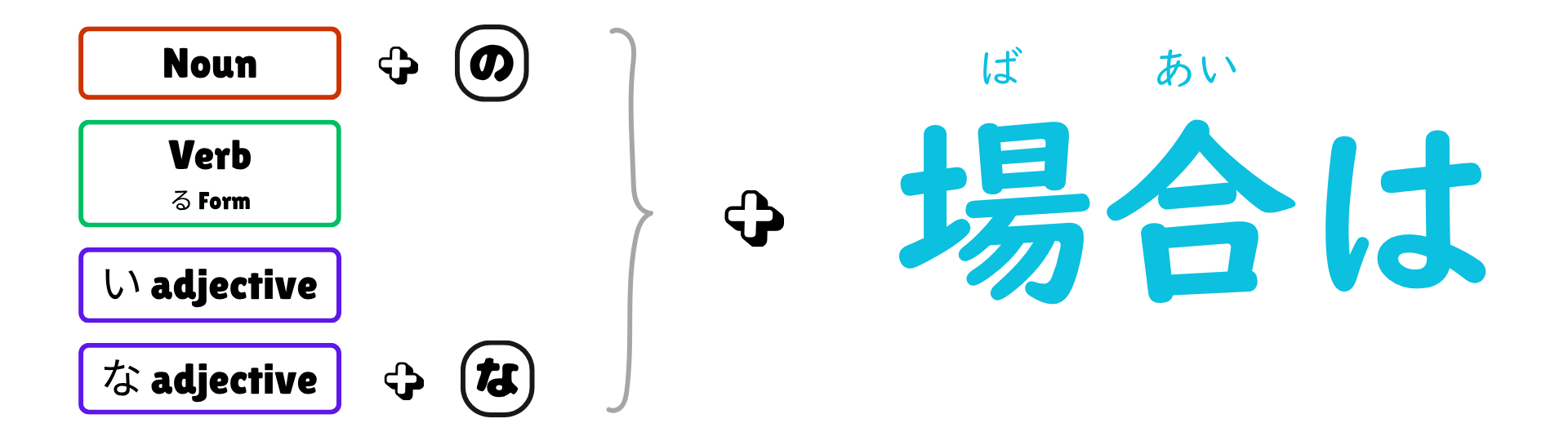
It is a grammar pattern used to describe a specific condition or situation, especially in rules, instructions, and explanations of what to do if something happens.
Think of it like the phrase “In case of emergency” in English.
Whether you are traveling, working, or handling everyday situations, 場合は helps you explain conditions clearly and calmly.
Let’s learn how to use it so you are always prepared!
Ready? Let’s go!


時 (とき / toki) vs 場合は (ばあいは / baai ha)
Both expressions refer to a situation or time, but the nuance is different.
時 (とき / toki)
時 simply indicates when something happens.
It is broad and commonly used for everyday timing or general situations.
ご飯を食べる時、いただきますと言います。
ごはんをたべるとき、いただきますといいます。
gohan wo taberu toki, itadakimasu to iimasu.
When I eat a meal, I say “itadakimasu.”
場合は (ばあいは / baai ha)
場合は focuses on a specific condition or hypothetical case.
It is often used in instructions, rules, manuals, and explanations of what action should be taken if something happens.
火事の場合は、エレベーターを使わないでください。
かじのばあいは、えれべーたーをつかわないでください。
kaji no baai ha, erebeetaa wo tsukawanaide kudasai.
In the case of a fire, please do not use the elevator.

雨の場合は、イベントは中止です。
あめのばあいは、いべんとはちゅうしです。
ame no baai ha, ibento ha chuushi desu.
In case of rain, the event will be canceled.
初心者の場合は、このコースがおすすめです。
しょしんしゃのばあいは、このこーすがおすすめです。
shoshinsha no baai ha, kono koosu ga osusume desu.
If you are a beginner, this course is recommended.
遅れる場合は、連絡してください。
おくれるばあいは、れんらくしてください。
okureru baai ha, renraku shite kudasai.
If you will be late, please contact us.
パスワードを忘れた場合は、こちらから再設定してください。
ぱすわーどをわすれたばあいは、こちらからさいせっていしてください。
pasuwaado wo wasureta baai ha, kochira kara saisettei shite kudasai.
If you forget your password, please reset it from here.
時間がない場合は、明日でも大丈夫です。
じかんがないばあいは、あしたでもだいじょうぶです。
jikan ga nai baai ha, ashita demo daijoubu desu.
If you don’t have time, tomorrow is fine too.
熱が下がらない場合は、病院へ行ってください。
ねつがさがらないばあいは、びょういんへいってください。
netsu ga sagaranai baai ha, byouin he itte kudasai.
If your fever does not go down, please go to the hospital.
サイズが小さい場合は、交換できます。
さいずがちいさいばあいは、こうかんできます。
saizu ga chiisai baai ha, koukan dekimasu.
If the size is small, it can be exchanged.
助けが必要な場合は、スタッフを呼んでください。
たすけがひつようなばあいは、すたっふをよんでください。
tasuke ga hitsuyou na baai ha, sutaffu wo yonde kudasai.
If you need help, please call a staff member.

- Grammar Point: 場合は (ばあい は / baai ha)
- JLPT Level: N4
- Meaning: In the case of, in the event that
- Quick Explanation: Use 場合は to describe a specific condition or hypothetical situation, especially when explaining rules, procedures, or what action should be taken if a problem occurs.
So that’s how we use 場合は.
It’s a very useful expression when you want to talk about conditions, rules, or what to do if something happens.
日本語の勉強で迷った場合は、いつでも私のところに来てください。
にほんごのべんきょうでまよったばあいは、いつでもわたしのところにきてください。
nihongo no benkyou de mayotta baai ha, itsudemo watashi no tokoro ni kite kudasai.
If you ever feel lost in your Japanese studies, please come to me anytime.
You are not alone on this journey.
Step by step, let’s keep learning Japanese together.
Your Sensei,
Hikari 👩🏻🏫✨
Get Hikari's JLPT Mock Exams & Preparation Lessons!
Whether you are studying to pass the JLPT or looking for a challenge in your learning journey, these courses are perfect for you!
Join my ニュースレター Newsletter 📩
You can expect an email from me once a week about Japanese culture.
Don't worry, your information will not be shared.
We hate SPAM. We will never sell your information, for any reason.