JLPT N3 - Grammar 🌟 代わりに kawari ni
Have you ever run out of milk and had to use soy milk instead?
Or maybe your boss was sick, and you ended up attending a very important meeting in their place.
In Japanese, when you want to say “instead of,” “in place of,” or “in exchange for,” we use the super useful expression 代わりに (かわりに / kawari ni) .
It’s a versatile N3 grammar point that helps you talk about replacements and trade offs in a natural, everyday way.
You can use 代わりに when something takes the place of something else, or when you do one thing to make up for another.
It works for people, objects, actions, and even situations where there’s a clear give and take.
Let’s take a closer look at how it works, so you can start using 代わりに with confidence in real life.
Ready? Let’s go!


ないで (naide) vs 代わりに (kawari ni)
Both expressions can be translated as “instead of,” but the nuance and focus are different.
ないで (naide)
ないで simply describes that one action did not happen, while another action did.
It does not emphasize replacement, compensation, or exchange.
The sentence is more descriptive and neutral, focusing on what was or was not done.
野菜を食べないで、肉を食べる。
やさい を たべないで、にく を たべる。
yasai wo tabenaide, niku wo taberu.
I eat meat without eating vegetables.
代わりに (kawari ni)
代わりに clearly shows replacement or compensation.
One thing takes the place of another, or one action is done to make up for something else.
It often implies a conscious choice or balance between two options.
野菜を食べる代わりに、サプリメントを飲む。
やさい を たべる かわり に、さぷりめんと を のむ。
yasai wo taberu kawari ni, sapurimento wo nomu.
Instead of eating vegetables, I take supplements.

出張中の同僚の代わりに、私がミーティングに出ます。
しゅっちょうちゅうのどうりょうのかわりに、わたしがみーてぃんぐにでます。
shucchou chuu no douryou no kawari ni, watashi ga miitingu ni demasu.
I will attend the meeting instead of my coworker, who is on a business trip.
牛乳の代わりに、豆乳を入れてコーヒーを飲んだ。
ぎゅうにゅうのかわりに、とうにゅうをいれてこーひーをのんだ。
gyuunyuu no kawari ni, tounyuu wo irete koohii wo nonda.
I drank coffee using soy milk instead of regular milk.
映画館に行く代わりに、家でネットフリックスを見ることにする。
えいがかんにいくかわりに、いえでねっとふりっくすをみることにする。
eigakan ni iku kawari ni, ie de nettofurikkusu wo miru koto ni suru.
Instead of going to the movie theater, I decided to watch Netflix at home.
料理を作ってもらう代わりに、私が皿洗いをします。
りょうりをつくってもらうかわりに、わたしがさらあらいをします。
ryouri wo tsukutte morau kawari ni, watashi ga saraarai wo shimasu.
Instead of having someone cook, I will do the dishes.
この部屋は日当たりが良い代わりに、家賃が少し高い。
このへやはひあたりがいいかわりに、やちんがすこしたかい。
kono heya ha hiatari ga ii kawari ni, yachin ga sukoshi takai.
This room gets great sunlight, but the rent is a little high.
この机は丈夫な代わりに、他のものよりかなり重いです。
このつくえはじょうぶなかわりに、ほかのものよりかなりおもいです。
kono tsukue ha joubu na kawari ni, hoka no mono yori kanari omoi desu.
This desk is sturdy, but it is much heavier than others.
宿題を手伝ってあげる。その代わりにあとでアイスおごってね!
しゅくだいをてつだってあげる。そのかわりにあとであいすおごってね。
shukudai wo tetsudatte ageru. sono kawari ni atode aisu ogotte ne.
I’ll help you with your homework. In exchange, treat me to ice cream later.

- Grammar Point: 代わりに (kawari ni)
- JLPT Level: N3
- Meaning: Instead of, in place of, in exchange for
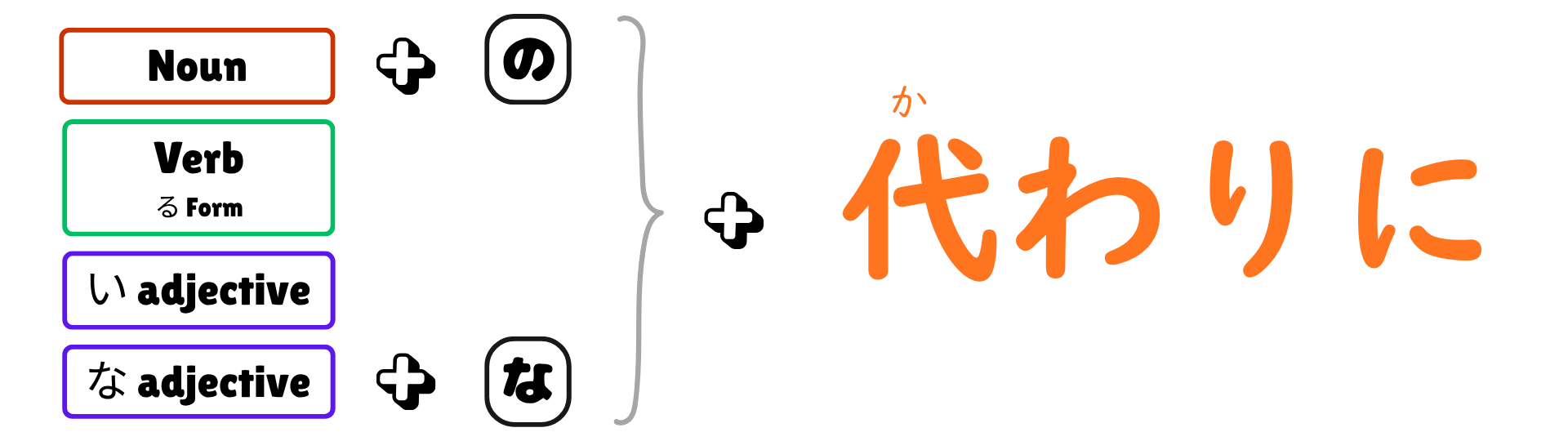
- Quick Explanation: Use 代わりに when one thing replaces another, or when there is a clear trade off. It works for people, objects, actions, and even pros and cons.
So that’s how we use 代わりに.
It’s a very practical expression for daily life, especially when plans change or when you make a deal with someone.
スマホをずっと見る代わりに、今日は新しい単語を一つ覚えてみませんか?
すまほをずっとみているかわりに、きょうはあたらしいたんごをひとつおぼえてみませんか?
sumaho wo zutto miru kawari ni, kyou ha atarashii tango wo hitotsu oboete mimasen ka?
Instead of scrolling on your phone, why not try learning just one new word today?
Now it’s your turn.
Try making your own sentence using 代わりに and say it out loud or write it down.
Small choices like this add up to big progress.
Your Sensei,
Hikari 👩🏻🏫✨
Get Hikari's JLPT Mock Exams & Preparation Lessons!
Whether you are studying to pass the JLPT or looking for a challenge in your learning journey, these courses are perfect for you!
Join my ニュースレター Newsletter 📩
You can expect an email from me once a week about Japanese culture.
Don't worry, your information will not be shared.
We hate SPAM. We will never sell your information, for any reason.