JLPT N2 - Grammar 🌟 抜きで / 抜きにして nuki de / nuki ni shite
Imagine this,
you’re visiting your best friend’s place, and they’re making coffee for you.
They know exactly how you like it. Milk, and two spoons of sugar. Always.
So they smile and ask “Same as usual?”
But today, you hesitate for a second.
You remember your recent health check, and the numbers were a little higher than expected.
So you say “Actually… today, without sugar, please.”
In Japanese, 抜きで (ぬきで / nuki de) and 抜きにして (ぬきにして / nuki ni shite) are used in moments just like this.
When you intentionally leave something out. An ingredient, a person, a condition, or even feelings like jokes or formalities.
Let’s look at how these expressions work, and how to use them naturally in everyday Japanese.

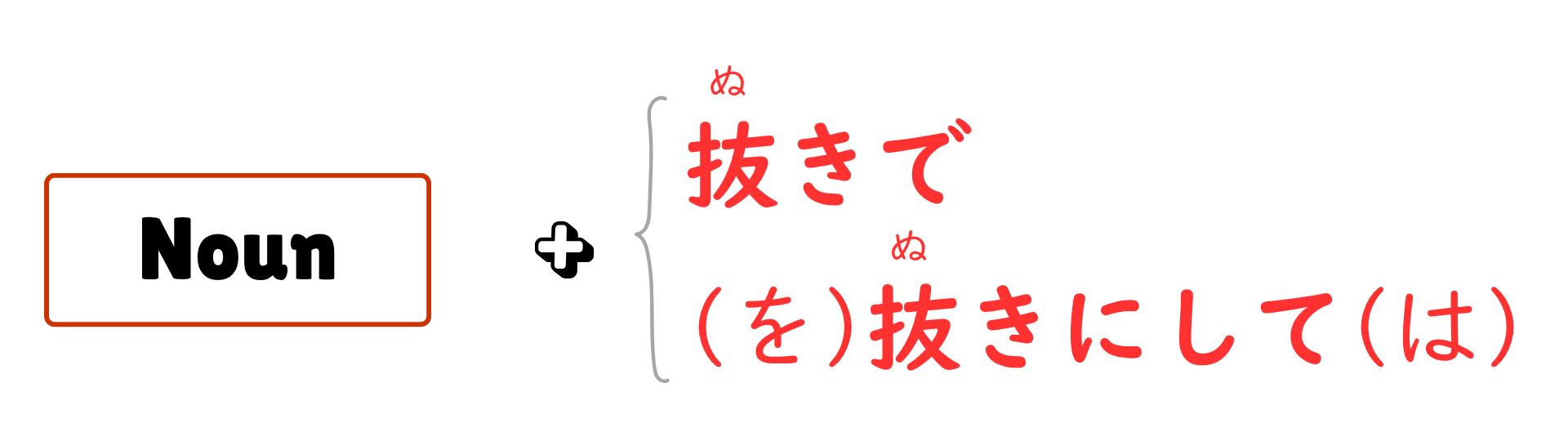

Choosing Between 抜きで (nuki de) and 抜きにして (nuki ni shite)
Both 抜きで and 抜きにして mean “leaving something out,” and in many situations, they can be used interchangeably.
However, depending on the context, one may sound more natural than the other.
抜きで (nuki de)
抜きで is mainly used for physical or concrete things, such as food ingredients or people.
今日は砂糖抜きでお願いします。
きょう は さとう ぬき で おねがい します。
kyou ha satou nuki de onegai shimasu.
Today, without sugar, please.
Use 抜きで (nuki de) when you are simply omitting something tangible.
抜きにして(は) (nuki ni shite (ha))
抜きにして is better suited for abstract things, such as jokes, emotions, formalities, or conditions in a discussion.
冗談を抜きにして、真剣に話そう。
じょうだん を ぬき に して、しんけん に はなそう。
joudan wo nuki ni shite, shinken ni hanasou.
Jokes aside, let’s talk seriously.
Use 抜きにして (nuki ni shite) when you want to set something aside mentally and focus on the main point.
除いて (nozoite) vs 抜きで (nuki de) / 抜きにして (nuki ni shite)
除いて(のぞいて) also means “excluding,” but it sounds more neutral and factual.
It is often used to state rules, schedules, or objective conditions, rather than a personal choice.
日曜日を除いて、毎日営業しています。
にちようび を のぞいて、まいにち えいぎょう して います。
nichiyoubi wo nozoi te, mainichi eigyou shite imasu.
We are open every day except Sunday.
Compared to this, 抜きで (nuki de) / 抜きにして (nuki ni shite) feel more intentional and conversational, showing that someone actively decided to leave something out.

今日は寝坊したので、朝食抜きで家を出た。
きょう は ねぼう した の で、ちょうしょく ぬき で いえ を でた。
kyou ha nebou shita no de, choushoku nuki de ie wo deta.
I overslept today, so I left home without eating breakfast.
私はいつも、お寿司をわさび抜きで注文します。
わたし は いつも、おすし を わさび ぬき で ちゅうもん します。
watashi ha itsumo, osushi wo wasabi nuki de chuumon shimasu.
I always order sushi without wasabi.
次の旅行は、親抜きで友達だけで行きたいな!
つぎ の りょこう は、おや ぬき で ともだち だけ で いきたい な!
tsugi no ryokou ha, oya nuki de tomodachi dake de ikitai na!
For the next trip, I want to go with just friends, without my parents!
インターネットを抜きにしては、現代の生活は成り立たない。
いんたーねっと を ぬき に して は、げんだい の せいかつ は なりたたない。
intaanetto wo nuki ni shite ha, gendai no seikatsu ha naritatanai.
Without the internet, modern life cannot function.
冗談抜きで、昨日のテストは本当に難しかった。
じょうだん ぬき で、きのう の てすと は ほんとう に むずかしかった。
joudan nuki de, kinou no tesuto ha hontou ni muzukashikatta.
Jokes aside, yesterday’s test was really difficult.
お世辞抜きにして、あなたの日本語は本当に上手ですね。
おせじ を ぬき に して、あなた の にほんご は ほんとう に じょうず です ね。
oseji wo nuki ni shite, anata no nihongo ha hontou ni jouzu desu ne.
Flattery aside, your Japanese is really good.

- Grammar Point: 抜きで / 抜きにして (nuki de / nuki ni shite)
- JLPT Level: N2
- Meaning: Without, leaving out, setting aside
- Quick Explanation: 抜きで and 抜きにして are used when you intentionally leave something out.
So that’s how we use 抜きで / 抜きにして!
They are very useful expressions when you want to be clear, honest, and direct in Japanese.
昨日私は朝ごはん抜きで仕事に行きました。
きのうわたしはあさごはんぬきでしごとにいきました。
Kinou watashi wa asagohan nuki de shigoto ni ikimashita.
Yesterday, I went to work without eating breakfast.
Now, it’s your turn!
Try making your own sentence with 抜きで or 抜きにして.
Think about something you want to leave out and say it in Japanese.
Your Sensei,
Hikari 👩🏻🏫✨
Get Hikari's JLPT Mock Exams & Preparation Lessons!
Whether you are studying to pass the JLPT or looking for a challenge in your learning journey, these courses are perfect for you!
Join my ニュースレター Newsletter 📩
You can expect an email from me once a week about Japanese culture.
Don't worry, your information will not be shared.
We hate SPAM. We will never sell your information, for any reason.