JLPT N2 - Grammar 🌟 もの / もん mono / mon
Have you ever found yourself making a little excuse or trying to justify your actions to a friend?
Imagine you are on a dream trip to Japan. You went to Don Quijote or a pharmacy “just to look,” but you came out with bags full of matcha snacks, ten different types of sunscreen, and enough steam eye masks to last a decade!
When your friend looks at your overflowing suitcase and asks, “Did you really need all of this?” you might feel like pouting and saying, “But they were on sale!” or “But I can’t buy these back home!”
When someone asks, “Why did you do that?” you want to say “Because I wanted to!”, but with a touch of “Don’t judge me!” or even a slightly cute, defensive vibe.
That’s exactly where もの (mono) or もん (mon) comes in!
It’s a super expressive N2 grammar point used at the end of a sentence to give a personal reason, especially when you’re acting a bit spoiled, making an excuse, or lightly talking back.
It’s like saying “because…” but with a lot of feeling behind it.
Let’s learn how to use this to show your human side and add some personality to your Japanese!
Ready? Let’s go!

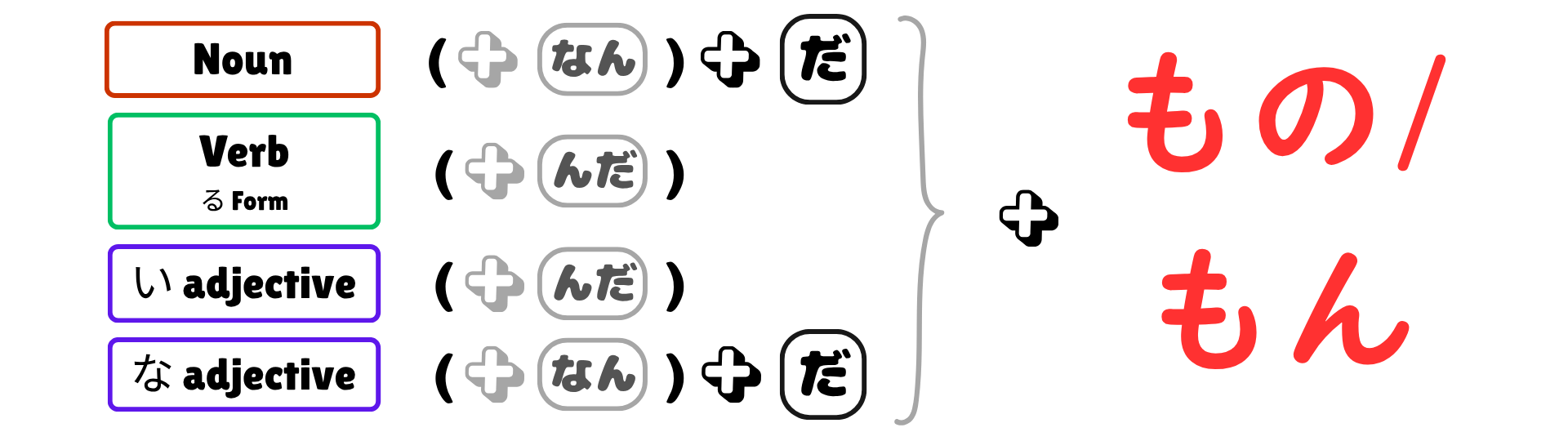

から (kara) vs もの / もん (mono / mon)
Both are used to explain a reason, but the vibe is totally different.
から (kara)
から is a neutral and logical way to state a cause. It sounds objective and calm.
雨が降っているから、いきません。
あめ が ふっている から、いきません。
ame ga futteiru kara, ikimasen.
I won’t go because it’s raining. (Standard, logical reason)
もの / もん (mono / mon)
もの/もん are subjective and emotional. It often sounds like “What can I do?” or “I have my reasons!” Mostly used with family or close friends.
だって、雨が降っているんだもん。
だって、あめ が ふっているんだ もん。
datte, ame ga futteirunda mon.
But it’s raining! (Making an excuse / pouting)
💡 Tip:
もん is the very casual, spoken version of もの.
Using these can sound a bit childish or spoiled, so avoid them in business or formal situations. In those cases, stick to から or ので.
Why does もの / もん mean “because”?
Originally, もの is a noun meaning “thing” or “matter.”
It comes from expressions like 「〜というものだ (~to iu mono da)」 (“That’s just how things are”).
Over time, this structure evolved, and もの started being used at the end of sentences to explain a personal reason or justification, often with emotion.
That’s why もの / もん sounds less logical and more emotional than から.

一生懸命がんばって作ったんだもの、残さず食べてほしいよ。
いっしょうけんめい がんばって つくった んだ もの、のこさず たべて ほしい よ。
isshoukenmei ganbatte tsukutta n da mono, nokosazu tabete hoshii yo.
I worked really hard to make it, so I want you to eat it all.
もうお腹がいっぱいになっちゃったんだもん。
もう おなか が いっぱい に なっちゃった んだ もん。
mou onaka ga ippai ni nacchatta n da mon.
I’m already full, you know.
だって、これ欲しかったんだもん。
だって、これ ほしかった んだ もん。
datte, kore hoshikatta n da mon.
But I really wanted this!
今日は朝から何も食べていないもの、お腹がすくよ。
きょうはあさからなにもたべていないもの、おなかがすくよ。
Kyou wa asa kara nani mo tabete inai mono, onaka ga suku yo.
I haven’t eaten anything since this morning, so of course I’m hungry.
仕方ないじゃない、彼女のことが好きなんだもの。
しかたない じゃない、かのじょ の こと が すき な んだ もの。
shikatanai janai, kanojo no koto ga suki na n da mono.
You can’t help it, you like her.
この部屋は静かだもん、ここで仕事したい。
このへやはしずかだもん、ここでしごとしたい。
kono heya wa shizuka da mon, koko de shigoto shitai.
This room is quiet, so I want to work here.
このケーキは甘いんだもん、たくさん食べられないよ。
このけーきはあまいんだもん、たくさんたべられないよ。
Kono keeki wa amain da mon, takusan taberarenai yo.
This cake is so sweet, so I can’t eat a lot of it.
今日はすごく寒いもの、外に出たくない。
きょうはすごくさむいもの、そとにでたくない。
Kyou wa sugoku samui mono, soto ni detakunai.
It’s really cold today, so I don’t want to go outside.
だって、まだ子供だもん。
だって、まだ こども だ もん。
datte, mada kodomo da mon.
But I’m still just a kid.
今日は僕の誕生日なんだもん。少しくらいわがまま聞いてよ!
きょう は ぼく の たんじょうび な んだ もん。すこし くらい わがまま きいて よ!
kyou ha boku no tanjoubi na n da mon. sukoshi kurai wagamama kiite yo!
Today is my birthday! Let me be a little selfish, okay?

- Grammar Point: もの / もん (mono / mon)
- JLPT Level: N2
- Meaning: Because, the reason is…
- Quick Explanation: Use もの or もん when you want to give a personal reason or excuse.
It adds an emotional, human tone and often sounds a bit like pouting or self-justification.
So that’s how we use もの and もん!
It’s a great way to explain your feelings in a very natural, human way. Just remember to save it for casual situations with people you’re close to.
勉強さぼっちゃった?うん、仕方ないよ。人間だもん。
べんきょう さぼっちゃった?うん、しかたない よ。にんげん だ もん。
benkyou sabocchatta? un, shikatanai yo. ningen da mon.
Did you skip studying? Yeah, it can’t be helped. We’re only human.
Keep noticing these little emotional details as you study Japanese.
They may seem small, but they add warmth and personality to your Japanese faster than you think.
Your Sensei,
Hikari 👩🏻🏫✨
Get Hikari's JLPT Mock Exams & Preparation Lessons!
Whether you are studying to pass the JLPT or looking for a challenge in your learning journey, these courses are perfect for you!
Join my ニュースレター Newsletter 📩
You can expect an email from me once a week about Japanese culture.
Don't worry, your information will not be shared.
We hate SPAM. We will never sell your information, for any reason.