JLPT N1 - Grammar 🌟 可能性がある kanousei ga aru
Have you ever looked at a dark, cloudy sky and thought, "Hmm, it might rain later"?
Or maybe, after a dream-like trip to Japan where you enjoyed too much delicious food and shopping at Donki, you’re looking at your bank account and thinking, "There’s a chance I might be broke by next week..."
In casual Japanese, we often use かもしれない (kamoshirenai) for these feelings.
But what if you want to sound more professional, objective, or scientific?
Whether you're presenting a business report, listening to a weather forecast, or discussing a serious medical topic, you need a word that talks about "probability" and "potential."
That’s where 可能性がある (かのうせいがある / kanousei ga aru) comes in!
It’s a sophisticated N1 expression that means "there is a possibility" or "it might."
While かもしれない is based on your gut feeling, 可能性がある sounds like you have a reason or data to back it up.
It’s the difference between saying "I think so" and "Statistics show there is a chance."
Let’s dive into how to use this cool, intellectual phrase to level up your Japanese!


かもしれない (kamo shirenai) vs 可能性がある (kanousei ga aru)
Both expressions are used to talk about things that are not 100% certain, but they differ in tone, objectivity, and typical usage.
かもしれない (kamo shirenai)
かもしれない is very common in daily conversation.
It is subjective, based on the speaker’s personal feeling, guess, or intuition.
明日は雨が降るかもしれない。
あした は あめ が ふる かもしれない。
ashita ha ame ga furu kamoshirenai.
It might rain tomorrow. (Just my guess.)
Use かもしれない when you are casually sharing an uncertain thought.
可能性がある (kanousei ga aru)
可能性がある sounds more formal and objective.
It implies that there is some logical basis, data, or evidence behind the statement.
It is often used in news, business, academic writing, or professional discussions.
明日は大雨になる可能性があります。
あした は おおあめ に なる かのうせい が あります。
ashita ha ooame ni naru kanousei ga arimasu.
There is a possibility of heavy rain tomorrow. (Based on data.)
Use 可能性がある when you want to sound careful, factual, or professional.

このまま対策をしなければ、失敗する可能性があります。
この まま たいさく を しなければ、しっぱい する かのうせい が あります。
kono mama taisaku wo shinakereba, shippai suru kanousei ga arimasu.
If we don’t take measures, there is a possibility we will fail.
古い建物なので、地震で壊れる可能性があります。
ふるい たてもの なので、じしん で こわれる かのうせい が あります。
furui tatemono nanode, jishin de kowareru kanousei ga arimasu.
Since it’s an old building, there is a possibility it could collapse in an earthquake.
今の成績だと、試験に合格できない可能性がある。
いま の せいせき だと、しけん に ごうかく できない かのうせい が ある。
ima no seiseki da to, shiken ni goukaku dekinai kanousei ga aru.
With these grades, there is a possibility that you may not pass the exam.
この病気は遺伝の可能性があります。
この びょうき は いでん の かのうせい が あります。
kono byouki wa iden no kanousei ga arimasu.
This illness has a possibility of being hereditary.
予定変更の可能性がありますので、最新情報を必ずチェックしてください。
よてい へんこう の かのうせい が あります ので、さいしん じょうほう を かならず ちぇっく して ください。
yotei henkou no kanousei ga arimasu node, saishin jouhou wo kanarazu chekku shite kudasai.
There is a possibility of schedule changes, so please be sure to check the latest information.

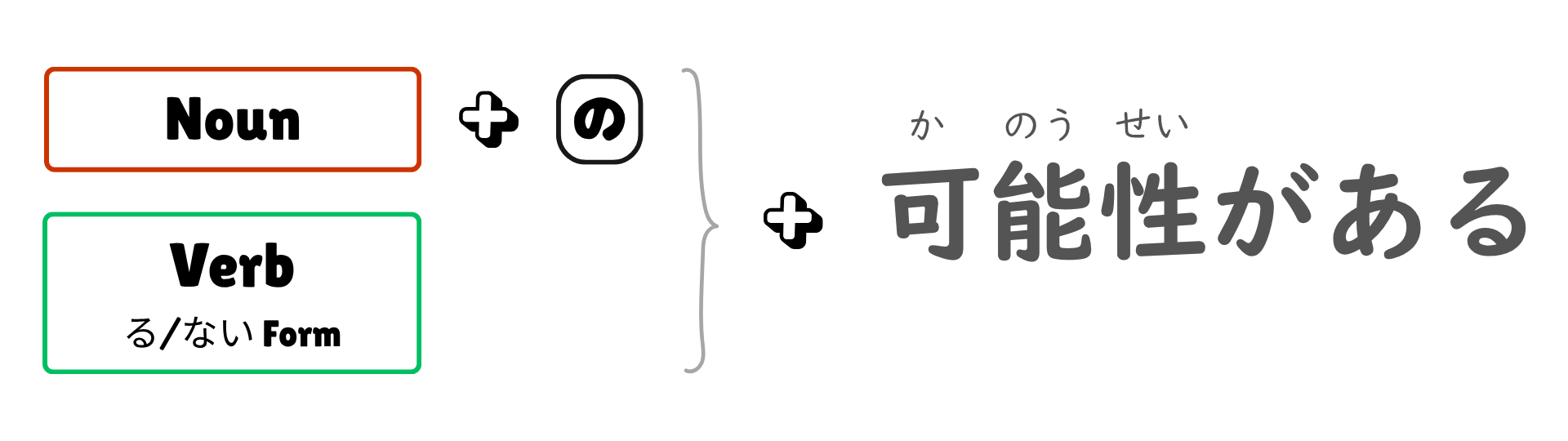
- Grammar Point: 可能性がある (かのうせい が ある / kanousei ga aru)
- JLPT Level: N1
- Meaning: There is a possibility, may, might
- Quick Explanation: Use 可能性がある when you want to describe something that may happen based on objective facts or logical reasoning.
So that’s how we use 可能性がある!
It’s a great expression for sounding precise and thoughtful when talking about uncertain outcomes, especially in formal or careful situations.
台風で電車が遅れる可能性があります。
たいふうででんしゃがおくれるかのうせいがあります。
Taifuu de densha ga okureru kanousei ga arimasu.
There is a possibility that trains will be delayed due to the typhoon.
Now it’s your turn!
Think about something in your life and try making your own sentence using 可能性がある.
Your Sensei,
Hikari 👩🏻🏫✨
Get Hikari's JLPT Mock Exams & Preparation Lessons!
Whether you are studying to pass the JLPT or looking for a challenge in your learning journey, these courses are perfect for you!
Join my ニュースレター Newsletter 📩
You can expect an email from me once a week about Japanese culture.
Don't worry, your information will not be shared.
We hate SPAM. We will never sell your information, for any reason.