JLPT N1 - Grammar 🌟 ほうがましだ hou ga mashi da
Have you ever faced two options that were both… honestly terrible?
Not good vs. bad, but bad vs. even worse?
Maybe it’s a rainy Monday morning, and you have to choose between walking 20 minutes in the heavy rain or squeezing yourself into a bus packed like sardines.
Neither sounds fun, but… one of them is still a little better, right?
Or imagine you’re traveling, and your only choices for dinner are a super overpriced restaurant or a long line in front of a cheap place. You’re tired, you’re hungry, and both options feel painful, but you still have to choose the less miserable one.
Or maybe your boss gives you two impossible tasks, finish everything today with overtime,
or come in early tomorrow on your day off.
Ugh… neither is ideal, but you might be thinking, “If I have to choose, this one is still better than the other.”
In Japanese, there’s a perfect expression for these “bad vs. worse” situations: ほうがましだ(hou ga mashi da). It’s used when you want to say “I’d rather do X than Y”, even though neither option is actually good.
Ready to master this “less terrible choice” expression? Alright, here we go!


💡Common Usage Patterns:
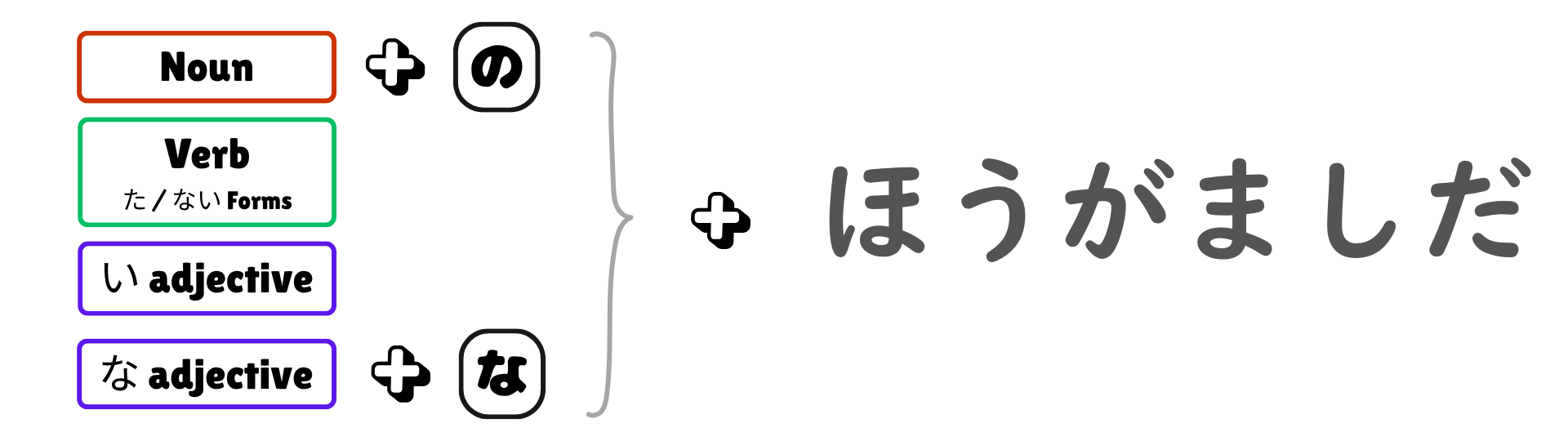
[ Option A ] + より、[ Option B ] + ほうがましだ
→ “I’d rather do B than A.”
[ Option A ] + くらいなら、[ Option B ] + ほうがましだ
→ “If I have to choose, B is still better than A.”
💡ほうがいい (hou ga ii) vs ほうがましだ (hou ga mashi da)
Both expressions compare two options, but the feeling behind them is completely different.
ほうがいい (hou ga ii)
Used when giving advice, making a suggestion, or choosing the better or more desirable option. It’s neutral or positive, there is no frustration or negativity.
もっと 早く 寝たほうがいい。
もっと はやく ねた ほうがいい。
motto hayaku neta houga ii.
You should go to bed earlier. (a simple, positive suggestion)
ほうがましだ (hou ga mashi da)
Used when both choices are undesirable, but one is still less terrible than the other.
It often carries feelings like frustration, annoyance, resignation, or complaint.
満員電車に 乗るより、歩くほうがましだ。
まんいんでんしゃ に のる より、あるく ほうが ましだ。
mannin densha ni noru yori, aruku houga mashi da.
I’d rather walk than get on a packed train. (Both options are annoying)

この後 ずっと 後悔する くらいなら、どんなに 嫌でも いま 挑戦するほうがましだ。
このあと ずっと こうかい する くらいなら、どんなに いや でも いま ちょうせん する ほうが ましだ。
kono ato zutto koukai suru kurai nara, donnani iya demo ima chousen suru houga mashi da.
If I’m going to regret it forever, I’d rather challenge myself now, no matter how much I dislike it.
文句ばかり 言われる くらいなら、手伝わないほうがましだ。
もんく ばかり いわれる くらいなら、てつだわない ほうが ましだ。
monku bakari iwareru kurai nara, tetsudawanai houga mashi da.
If all I’m going to get is complaints, I’d rather not help at all.
子どもが 傷つかないので あれば、自分が 犠牲になったほうがましだ。
こども が きずつかない の で あれば、じぶん が ぎせい に なった ほうが ましだ。
kodomo ga kizutsukanai no de areba, jibun ga gisei ni natta houga mashi da.
If it means my child won’t get hurt, I’d rather sacrifice myself.
不幸な 結婚生活を 送る くらいなら、独身のほうがましだ。
ふこう な けっこんせいかつ を おくる くらいなら、どくしん の ほうが ましだ。
fukou na kekkon seikatsu wo okuru kurai nara, dokushin no houga mashi da.
If the alternative is an unhappy marriage, I’d rather stay single.
ぬるい ラーメンより、冷たい 白米のほうがましだ。
ぬるい らーめん より、つめたい はくまい の ほうが ましだ。
nurui raamen yori, tsumetai hakumai no houga mashi da.
Compared to lukewarm ramen, I’d rather eat cold white rice.
忙しい 生活より、退屈な 生活のほうがましだ。
いそがしい せいかつ より、たいくつ な せいかつ の ほうが ましだ。
isogashii seikatsu yori, taikutsu na seikatsu no houga mashi da.
I’d rather live a boring life than a busy one.
暑いより寒いほうがましだ。
あついよりさむいほうがましだ。
atsui yori samui hou ga mashi da.
Cold is better than hot.
うそをつくより正直なほうがましだ。
うそをつくよりしょうじきなほうがましだ。
uso wo tsuku yori shoujiki na hou ga mashi da.
Being honest is better than lying.

- Grammar Point: ほうがましだ (hou ga mashi da)
- JLPT Level: N1
- Meaning: Would rather, better than (when both options are unpleasant)
- Quick Explanation: ほうがましだ is used when you have two bad choices, but one of them is still “less terrible” than the other. It expresses a strong personal preference, usually with frustration, annoyance, or resignation.
So that’s how we use ほうがましだ!
It’s the perfect expression for those moments when none of the options feel good…
but you still have to choose the less painful one, whether it’s choosing effort over regret, staying single over a miserable marriage, or picking cold rice over lukewarm ramen.
雨の日に出かけるくらいなら、家にいたほうがましだ。
あめのひにでかけるくらいなら、いえにいたほうがましだ。
ame no hi ni dekakeru kurai nara, ie ni ita hou ga mashi da.
It’s better to stay home than to go out on a rainy day.
Now it’s your turn! Try making your own ほうがましだ sentences and express your “If I HAVE to choose, I’d rather…” thoughts just like a native speaker!
Your Sensei,
Hikari 👩🏻🏫✨
Get Hikari's JLPT Mock Exams & Preparation Lessons!
Whether you are studying to pass the JLPT or looking for a challenge in your learning journey, these courses are perfect for you!
Join my ニュースレター Newsletter 📩
You can expect an email from me once a week about Japanese culture.
Don't worry, your information will not be shared.
We hate SPAM. We will never sell your information, for any reason.