JLPT N1 - Grammar 🌟 羽目になる hame ni naru
![Claim offer create the alt text for this image: Alt text: Stylized Japanese hiragana character “や” (ya) labeled N5 on a blue background, indicating a beginner-level Japanese kana lesson or learning material. same foor ほうがいい Alt text: Japanese grammar expression “ほうがいい” displayed on a blue background, indicating the JLPT N5 structure used to give advice or suggest that someone should do something. same for へ Alt text: Japanese hiragana character “へ” labeled N5 on a blue background, representing the beginner-level Japanese particle “へ” used to indicate direction or destination. Alt text: Japanese verb “終わる” (owaru) labeled N4 on a teal background, meaning “to finish” or “to end,” for intermediate-level Japanese learning. koto Alt text: Japanese grammar word “こと” (koto) labeled N5 on a blue background, representing a basic Japanese structure used to nominalize verbs or refer to abstract things. it:s n4 Alt text: Japanese grammar word “こと” (koto) labeled N4 on a teal background, representing an intermediate-level structure used to nominalize verbs or refer to abstract concepts or experiences. Alt text: Japanese grammar pattern “にしては” (ni shite wa) labeled N3 on an orange background, used to express that something is unexpected or surprising given a certain standard. てはじめて Alt text: Japanese grammar pattern “てはじめて” (te hajimete) labeled N3 on an orange background, used to express “only after doing something for the first time.” Alt text: Japanese adverb “しかも” (shikamo) labeled N2 on a pink background, meaning “moreover,” “furthermore,” or “on top of that.” いきなり Alt text: Japanese adverb “いきなり” (ikinari) labeled N3 on an orange background, meaning “suddenly” or “all of a sudden.” n2 Alt text: Japanese adverb “いきなり” (ikinari) labeled N2 on a pink background, meaning “suddenly” or “without warning.” Alt text: Japanese grammar pattern “ずくめ” (zukume) labeled N1 on a dark gray background, used to indicate “entirely,” “completely,” or “nothing but.” tai n5 Alt text: Japanese grammar pattern “〜たい” (tai) labeled N5 on a blue background, used to express desire or wanting to do something. kara Alt text: Japanese particle “から” (kara) labeled N5 on a blue background, used to mean “from” or “because” in beginner-level Japanese grammar. ka Alt text: Japanese particle “か” (ka) labeled N5 on a blue background, used to mark a question or indicate alternatives in beginner-level Japanese grammar. teyokatta n4 Alt text: Japanese grammar pattern “〜てよかった” (te yokatta) labeled N4 on a teal background, used to express relief or that it was good that something happened or was done. atode n4 Alt text: Japanese grammar pattern “あとで” (ato de) labeled N4 on a teal background, meaning “later” or “afterwards,” used to indicate doing something later. ppanashi n3 Alt text: Japanese grammar pattern “っぱなし” (ppanashi) labeled N3 on an orange background, used to indicate something left in a certain state or left undone (e.g., left open, left on). kotoohanai n3 Alt text: Japanese grammar pattern “ことはない” (koto wa nai) labeled N3 on an orange background, used to express that there is no need to do something or that something is not necessary. hanmen n2 Alt text: Japanese grammar pattern “反面” (hanmen) labeled N2 on a pink background, used to express contrast, meaning “while,” “although,” or “on the other hand.” futatabi n2 Alt text: Japanese adverb “再び” (futatabi) labeled N2 on a pink background, meaning “again,” “once more,” or “a second time.” semete n2 Alt text: Japanese adverb “せめて” (semete) labeled N2 on a pink background, meaning “at least” or “at the very least.” gurumi n1 Alt text: Japanese grammar suffix “〜ぐるみ” (gurumi) labeled N1 on a dark gray background, used to mean “as a whole,” “including,” or “together with” (e.g., familyぐるみ, companyぐるみ). kaimonaku n1 Alt text: Japanese grammar pattern “〜かいもなく” (kaimonaku) labeled N1 on a dark gray background, used to express that something happened without any sense of reward, effort being wasted, or “not worth the trouble.” まで n5 Alt text: Japanese particle “まで” (made) labeled N5 on a blue background, meaning “until,” “up to,” or “as far as” in beginner-level Japanese grammar. か n5 )question particle Alt text: Japanese particle “か” (ka) labeled N5 on a blue background, used as a question particle to mark a sentence as a question. かな n4 Alt text: Japanese sentence-ending expression “かな” (kana) labeled N4 on a teal background, used to express uncertainty, self-reflection, or wondering (e.g., “I wonder…”). おきに n4 Alt text: Japanese grammar pattern “〜おきに” (oki ni) labeled N4 on a teal background, used to indicate intervals, meaning “every” (e.g., every two days). くせに n3 Alt text: Japanese grammar pattern “〜くせに” (kuseni) labeled N3 on an orange background, used to express criticism or contradiction, meaning “even though” or “despite.” いくら~ても n3 Alt text: Japanese grammar pattern “いくら〜ても” (ikura ~ temo) labeled N3 on an orange background, used to mean “no matter how much” or “even if.” ちっとも~ない n2 Alt text: Japanese grammar pattern “ちっとも〜ない” (chittomo ~ nai) labeled N2 on a pink background, used to mean “not at all” or “not in the least.” かと思ったら Alt text: Japanese grammar pattern “かと思ったら” (ka to omottara) labeled N3 on an orange background, used to express that something happened immediately after or unexpectedly after thinking something. n 2 Alt text: Japanese grammar pattern “かと思ったら” (ka to omottara) labeled N2 on a pink background, used to express that something happened immediately after or contrary to what was expected. なくしては n1 Alt text: Japanese grammar pattern “〜なくしては” (nakushite wa) labeled N1 on a dark gray background, used to express that something cannot happen or exist without something else (“without…, cannot…”). ためしがない n1 Alt text: Japanese grammar pattern “〜ためしがない” (tameshi ga nai) labeled N1 on a dark gray background, used to express that something has never happened or has never been experienced. に行く n Alt text: Japanese grammar pattern “〜に行く” (ni iku) labeled N5 on a blue background, used to express going somewhere to do something (e.g., go to eat, go to buy). な-adjectives n Alt text: Japanese grammar category “な-adjectives” labeled N5 on a blue background, referring to adjectives that require “な” when modifying a noun. い-adjectives n Alt text: Japanese grammar category “い-adjectives” labeled N5 on a blue background, referring to adjectives that end in “い” and conjugate like verbs in beginner-level Japanese. てください n5 Alt text: Japanese grammar pattern “〜てください” (te kudasai) labeled N5 on a blue background, used to make polite requests or ask someone to do something. 予定だ n4 Alt text: Japanese grammar pattern “〜予定だ” (yotei da) labeled N4 on a teal background, used to express a plan or something that is scheduled or expected to happen. なかなか〜ない n4 Alt text: Japanese grammar pattern “なかなか〜ない” (nakanaka ~ nai) labeled N4 on a teal background, used to express that something is not easily done or does not happen easily. ことができる n4 Alt text: Japanese grammar pattern “ことができる” (koto ga dekiru) labeled N4 on a teal background, used to express ability or possibility, meaning “can do” or “be able to do.” たしかに Alt text: Japanese adverb “たしかに” (tashika ni) labeled N3 on an orange background, meaning “certainly,” “indeed,” or “surely.” がち n3 Alt text: Japanese grammar suffix “〜がち” (gachi) labeled N3 on an orange background, used to express that something tends to happen often or has a tendency to be a certain way. ただちに Alt text: Japanese adverb “ただちに” (tadachini) labeled N2 on a pink background, meaning “immediately” or “without delay.” かねる n2 Alt text: Japanese grammar pattern “〜かねる” (kaneru) labeled N2 on a pink background, used to express that something is difficult or impossible for the speaker to do. ても差し支えない n1 Alt text: Japanese grammar pattern “〜ても差し支えない” (temo sashitsukae nai) labeled N1 on a dark gray background, used to express that it is acceptable or there is no problem doing something (“may do,” “it’s okay to do”). あくまでも n1 Alt text: Japanese adverb “あくまでも” (akumademo) labeled N1 on a dark gray background, meaning “to the very end,” “strictly,” or “persistently (in a certain stance).” なる n5 Alt text: Japanese verb “なる” (naru) labeled N5 on a blue background, meaning “to become.” があります n5 Alt text: Japanese expression “〜があります” (ga arimasu) labeled N5 on a blue background, used to indicate existence of inanimate things or to say that something exists. に気がつく n4 Alt text: Japanese grammar expression “〜に気がつく” (ni ki ga tsuku) labeled N4 on a teal background, meaning “to notice,” “to realize,” or “to become aware of something.” てあげる n4 Alt text: Japanese grammar pattern “〜てあげる” (te ageru) labeled N4 on a teal background, used to express doing something for someone else as a favor. がる / がっている n4 Alt text: Japanese grammar pattern “〜がる / 〜がっている” (garu / gatte iru) labeled N4 on a teal background, used to express that someone appears to have a certain feeling or emotion. っぽい n3 Alt text: Japanese grammar suffix “〜っぽい” (ppoi) labeled N3 on an orange background, used to express “-ish,” “-like,” or having a tendency toward something. うちに n3 Alt text: Japanese grammar pattern “〜うちに” (uchi ni) labeled N3 on an orange background, used to express “while” or “before something changes,” indicating something happens during a certain time frame. いわゆる n2 Alt text: Japanese expression “いわゆる” (iwayuru) labeled N2 on a pink background, meaning “so-called” or “what is generally called.” たことがある n5 Alt text: Japanese grammar pattern “〜たことがある” (ta koto ga aru) labeled N5 on a blue background, used to express past experience, meaning “have done something before.” けど/けれども n5 Alt text: Japanese conjunction “けど / けれども” (kedo / keredomo) labeled N5 on a blue background, meaning “but,” “however,” or used to soften statements in beginner-level Japanese grammar. まま n4 Alt text: Japanese grammar pattern “〜まま” (mama) labeled N4 on a teal background, used to express leaving something as it is or doing something without changing the current state. ていただけませんか n4 Alt text: Japanese grammar pattern “〜ていただけませんか” (te itadakemasen ka) labeled N4 on a teal background, used to make very polite requests, meaning “Could you please…?” なかなか n3 Alt text: Japanese adverb “なかなか” (nakanaka) labeled N3 on an orange background, meaning “quite,” “fairly,” or “not easily,” depending on whether the sentence is positive or negative. つい n3 Alt text: Japanese adverb “つい” (tsui) labeled N3 on an orange background, used to express doing something unintentionally or without thinking, meaning “accidentally” or “without meaning to.” に向かって n25 Alt text: Japanese grammar pattern “〜に向かって” (ni mukatte) labeled N2 on a pink background, used to express direction toward something or addressing someone. つつある n2 Alt text: Japanese grammar pattern “〜つつある” (tsutsu aru) labeled N2 on a pink background, used to express that something is gradually changing or in the process of happening. を機に n1 Alt text: Japanese grammar pattern “〜を機に” (o ki ni) labeled N1 on a dark gray background, used to express “taking an opportunity as a turning point” or “on the occasion of.” いかに n1 Alt text: Japanese adverb “いかに” (ika ni) labeled N1 on a dark gray background, meaning “how,” “how much,” or “how greatly,” often used in formal or rhetorical expressions. だ / です n5 Alt text: Japanese copula “だ / です” (da / desu) labeled N5 on a blue background, used to state that something is or equals something in Japanese sentences. がいます / がいる n5 Alt text: Japanese expression “〜がいます / 〜がいる” (ga imasu / ga iru) labeled N5 on a blue background, used to indicate the existence of people or animals. させてください n4 Alt text: Japanese grammar pattern “〜させてください” (sasete kudasai) labeled N4 on a teal background, used to ask for permission to do something, meaning “please let me do…” から作る n4 Alt text: Japanese grammar pattern “〜から作る” (kara tsukuru) labeled N4 on a teal background, used to express making something from a specific material or ingredient. さえ n3 Alt text: Japanese grammar particle “〜さえ” (sae) labeled N3 on an orange background, used to mean “even” or “as long as,” depending on the context. と同時に n2 Alt text: Japanese grammar pattern “〜と同時に” (to douji ni) labeled N2 on a pink background, used to express that two actions happen at the same time or simultaneously. だけあって n2 Alt text: Japanese grammar pattern “〜だけあって” (dake atte) labeled N2 on a pink background, used to express that something is as expected because of a certain reason (“just as you’d expect from…”). を兼ねて n1 Alt text: Japanese grammar pattern “〜を兼ねて” (o kanete) labeled N1 on a dark gray background, used to express doing one thing while also serving another purpose (“also serves as,” “combined with”). に先駆けてに先駆けて n1 Alt text: Japanese grammar pattern “〜に先駆けて” (ni sakigakete) labeled N1 on a dark gray background, used to express doing something ahead of others or before something else as a precursor. てやまない n1 Alt text: Japanese grammar pattern “〜てやまない” (te yamanai) labeled N1 on a dark gray background, used to express strong, continuous feelings such as “cannot stop (feeling)” or “deeply/sincerely (hope, wish, or feel).” じみた n1 Alt text: Japanese grammar pattern “〜じみた” (jimita) labeled N1 on a dark gray background, used to mean “seems like,” “tinged with,” or “having the air of,” often with a slightly negative nuance. ませんか n5 Alt text: Japanese grammar pattern “〜ませんか” (masen ka) labeled N5 on a blue background, used to make polite invitations or suggestions, meaning “won’t you…?” or “shall we…?”. たり〜たり n5 Alt text: Japanese grammar pattern “〜たり〜たり” (tari ~ tari) labeled N5 on a blue background, used to list multiple actions in a non-exhaustive way, meaning “do things like… and…”. ているところ n4 Alt text: Japanese grammar pattern “〜ているところ” (te iru tokoro) labeled N4 on a teal background, used to indicate that an action is currently in progress at that exact moment. そんなに n4 Alt text: Japanese adverb “そんなに” (sonna ni) labeled N4 on a teal background, meaning “that much,” “so much,” or often used with negatives to mean “not that much.” 中 chuu/juu n3 Alt text: Japanese suffix “〜中” (ちゅう / じゅう – chuu / juu) labeled N3 on an orange background, used to mean “during,” “in the middle of,” or “throughout.” ぶりに n3 Alt text: Japanese grammar pattern “〜ぶりに” (buri ni) labeled N3 on an orange background, used to express doing something for the first time in a long time (“for the first time in…”). もう少しで n2 Alt text: Japanese expression “もう少しで” (mou sukoshi de) labeled N2 on a pink background, meaning “almost,” “in a little while,” or “just about to.” てたまらない n2 Alt text: Japanese grammar pattern “〜てたまらない” (te tamaranai) labeled N2 on a pink background, used to express that a feeling or desire is so strong that one cannot stand it. ほうがましだ n1 Alt text: Japanese grammar pattern “〜ほうがましだ” (hou ga mashi da) labeled N1 on a dark gray background, used to express that one option is preferable or less bad than another (“it would be better to…”). ずじまい n1 Alt text: Japanese grammar pattern “〜ずじまい” (zu jimai) labeled N1 on a dark gray background, used to express that something ended up not being done in the end. ね ne (sentence-ending particle) n5 Alt text: Japanese sentence-ending particle “ね” (ne) labeled N5 on a blue background, used to seek confirmation or agreement, similar to “right?” or “isn’t it?” in English. だけ n5 Alt text: Japanese particle “だけ” (dake) labeled N5 on a blue background, meaning “only” or “just.” たら n4 Alt text: Japanese grammar conditional form “〜たら” (tara) labeled N4 on a teal background, used to mean “if” or “when” something happens. がする n4 Alt text: Japanese grammar pattern “〜がする” (ga suru) labeled N4 on a teal background, used to express sensing something such as a smell, sound, or feeling. ないことはない n3 Alt text: Japanese grammar pattern “〜ないことはない” (nai koto wa nai) labeled N3 on an orange background, used to express that something is not impossible or that something can be done, meaning “it’s not that… not.” たとたん n3 Alt text: Japanese grammar pattern “〜たとたん” (ta totan) labeled N3 on an orange background, used to express that something happened immediately after something else. せっかく n2 Alt text: Japanese adverb “せっかく” (sekkaku) labeled N2 on a pink background, meaning “with much effort,” “specially,” or “since you’ve gone to the trouble.” かえって n2 Alt text: Japanese adverb “かえって” (kaette) labeled N2 on a pink background, meaning “on the contrary” or “all the more,” used when the result is opposite of what was expected. には無理がある n1 Alt text: Japanese grammar pattern “〜には無理がある” (ni wa muri ga aru) labeled N1 on a dark gray background, used to express that something is unreasonable, unrealistic, or too difficult. およそ n1 Alt text: Japanese adverb “およそ” (oyoso) labeled N1 on a dark gray background, meaning “approximately,” “about,” or “roughly.” ましょう n5 Alt text: Japanese grammar pattern “〜ましょう” (mashou) labeled N5 on a blue background, used to make suggestions or invitations, meaning “let’s…”. お / ご o / go (honorific prefix) n5 Alt text: Japanese honorific prefixes “お / ご” (o / go) labeled N5 on a blue background, used to make nouns and expressions polite or respectful in Japanese. たらどう n4 Alt text: Japanese grammar pattern “〜たらどう” (tara dou) labeled N4 on a teal background, used to give advice or suggestions, meaning “why don’t you…?”. がり n4 Alt text: Japanese grammar suffix “〜がり” (gari) labeled N4 on a teal background, used to describe someone who tends to feel or show a certain emotion or tendency (e.g., 怖がり, 寒がり). とは限らない n3 Alt text: Japanese grammar pattern “〜とは限らない” (to wa kagiranai) labeled N3 on an orange background, used to express that something is not necessarily the case or not always true. たびに n3 Alt text: Japanese grammar pattern “〜たびに” (tabi ni) labeled N3 on an orange background, used to mean “every time” something happens. をもとに n2 Alt text: Japanese grammar pattern “〜をもとに” (o moto ni) labeled N2 on a pink background, used to mean “based on” or “on the basis of.” からこそ n2 Alt text: Japanese grammar pattern “〜からこそ” (kara koso) labeled N2 on a pink background, used to emphasize that something is precisely because of a certain reason. さもないと n1 Alt text: Japanese conjunction “さもないと” (samo nai to) labeled N1 on a dark gray background, meaning “otherwise” or “or else.” とっさに n1 Alt text: Japanese adverb “とっさに” (tossa ni) labeled N1 on a dark gray background, meaning “instinctively,” “at once,” or “on the spur of the moment.” かつて n1 Alt text: Japanese adverb “かつて” (katsute) labeled N1 on a dark gray background, meaning “once,” “formerly,” or “in the past.” とりわけ n1 Alt text: Japanese adverb “とりわけ” (toriwake) labeled N1 on a dark gray background, meaning “especially,” “particularly,” or “above all.” ことなく n2 Alt text: Japanese grammar pattern “〜ことなく” (koto naku) labeled N2 on a pink background, used to express doing something without doing another action (“without…”). にて n2 Alt text: Japanese particle “にて” (nite) labeled N2 on a pink background, used as a formal or written equivalent of “で” to indicate location or means. あまり n3 Alt text: Japanese adverb “あまり” (amari) labeled N3 on an orange background, used with negatives to mean “not very” or “not much.” かける n3 Alt text: Japanese grammar suffix “〜かける” (kakeru) labeled N3 on an orange background, used to express that something has started but is not finished (“half-done,” “about to…”). さっき n4 Alt text: Japanese adverb “さっき” (sakki) labeled N4 on a teal background, meaning “a little while ago” or “just now.” てみる n4 Alt text: Japanese grammar pattern “〜てみる” (te miru) labeled N4 on a teal background, used to express trying something out to see what happens. ば n4 Alt text: Japanese conditional form “〜ば” (ba) labeled N4 on a teal background, used to express “if” in a formal or general conditional sense. なくてもいい n5 Alt text: Japanese grammar pattern “〜なくてもいい” (nakute mo ii) labeled N5 on a blue background, used to express that something is not necessary or that one doesn’t have to do something. にする n5 Alt text: Japanese grammar pattern “〜にする” (ni suru) labeled N5 on a blue background, used to express deciding on something or choosing something (“I’ll go with…”). まだ n5 Alt text: Japanese adverb “まだ” (mada) labeled N5 on a blue background, meaning “still” or “yet,” depending on whether the sentence is positive or negative. ずつ n3 Alt text: Japanese particle “〜ずつ” (zutsu) labeled N3 on an orange background, used to indicate distribution or doing something in equal amounts (e.g., “one by one,” “each”). の中で[A]が一番 n5 Alt text: Japanese grammar pattern “〜の中で[A]が一番” (no naka de [A] ga ichiban) labeled N5 on a blue background, used to express that something is the most within a group (“[A] is the most…”). どうやって n5 Alt text: Japanese expression “どうやって” (dou yatte) labeled N5 on a blue background, used to ask “how” something is done or achieved. それでも n4 Alt text: Japanese conjunction “それでも” (sore demo) labeled N4 on a teal background, meaning “even so,” “nevertheless,” or “still.” あまり〜ない n4 Alt text: Japanese grammar pattern “あまり〜ない” (amari ~ nai) labeled N4 on a teal background, used to express “not very” or “not much.” なるべく n3 Alt text: Japanese adverb “なるべく” (narubeku) labeled N3 on an orange background, meaning “as much as possible” or “if possible.” っけ n3 Alt text: Japanese sentence-ending particle “〜っけ” (kke) labeled N3 on an orange background, used to recall or confirm something from memory (“what was it again?”). といった n2 Alt text: Japanese grammar pattern “〜といった” (to itta) labeled N2 on a pink background, used to give examples or summarize a group (“such as,” “like,” or “the likes of”). からすると kara suruto / からすれば kara sureba n2 Alt text: Japanese grammar patterns “〜からすると / 〜からすれば” (kara suru to / kara sureba) labeled N2 on a pink background, used to express a judgment or viewpoint based on something (“from the perspective of,” “judging from”). であれ / であろうと de are / de arou to n1 Alt text: Japanese grammar patterns “〜であれ / 〜であろうと” (de are / de arou to) labeled N1 on a dark gray background, used to express “whether… or…” or “no matter what,” in a formal or emphatic way. JLPT N5 - Grammar 🌟 とても totemo Alt text: Japanese adverb “とても” (totemo) labeled N5 on a blue background, meaning “very” or “really,” used to strongly emphasize adjectives and adverbs. JLPT N5 - Grammar 🌟 でしょう deshou Alt text: Japanese auxiliary “でしょう” (deshou) labeled N5 on a blue background, used to express probability (“probably”) or to seek confirmation (“right?”) in a polite way. JLPT N4 - Grammar 🌟 と聞いた to kiita Alt text: Japanese grammar pattern “〜と聞いた” (to kiita) labeled N4 on a teal background, used to express hearsay, meaning “I heard that…”. JLPT N4 - Grammar 🌟 たばかり ta bakari Alt text: Japanese grammar pattern “〜たばかり” (ta bakari) labeled N4 on a teal background, used to express that something has just happened recently (“just did…”). JLPT N3 - Grammar 🌟 と言えば to ieba Alt text: Japanese grammar pattern “〜と言えば” (to ieba) labeled N3 on an orange background, used to bring up a topic or association (“speaking of…”). JLPT N3 - Grammar 🌟 ずに zuni Alt text: Japanese grammar pattern “〜ずに” (zuni) labeled N3 on an orange background, used to express doing something without doing another action (“without…”). JLPT N2 - Grammar 🌟 抜きで / 抜きにして nuki de / nuki ni shite Alt text: Japanese grammar patterns “〜抜きで / 〜抜きにして” (nuki de / nuki ni shite) labeled N2 on a pink background, used to mean “without,” “leaving out,” or “excluding.” JLPT N2 - Grammar 🌟 げ ge Alt text: Japanese suffix “〜げ” (ge) labeled N2 on a pink background, used to describe that someone appears to have a certain feeling or condition (e.g., 寂しげ, 嬉しげ). JLPT N1 - Grammar 🌟 てからというもの te kara to iu mono Alt text: Japanese grammar pattern “〜てからというもの” (te kara to iu mono) labeled N1 on a dark gray background, used to express that ever since a certain event, things have consistently changed or continued in a certain way. JLPT N1 - Grammar 🌟 かたわら katawara Alt text: Japanese grammar pattern “〜かたわら” (katawara) labeled N1 on a dark gray background, used to express doing one thing while also engaging in another activity (“while also…”). JLPT N5 - Grammar 🌟 方 kata Alt text: Japanese grammar pattern “〜方” (kata) labeled N5 on a blue background, used to express the way or method of doing something (“how to…”). JLPT N5 - Grammar 🌟 ないでください naide kudasai Alt text: Japanese grammar pattern “〜ないでください” (naide kudasai) labeled N5 on a blue background, used to make polite negative requests, meaning “please don’t…”. JLPT N4 - Grammar 🌟 必要 hitsuyou Alt text: Japanese noun/adjectival noun “必要” (ひつよう / hitsuyou) labeled N4 on a teal background, meaning “necessary” or “needed.” JLPT N4 - Grammar 🌟 にくい nikui Alt text: Japanese grammar suffix “〜にくい” (nikui) labeled N4 on a teal background, used to express that something is difficult to do. JLPT N3 - Grammar 🌟 向け muke Alt text: Japanese grammar suffix “〜向け” (muke) labeled N3 on an orange background, used to indicate that something is intended for a specific group or purpose (“for ~,” “targeted at ~”). JLPT N3 - Grammar 🌟 ふりをする furi wo suru Alt text: Japanese grammar pattern “〜ふりをする” (furi o suru) labeled N3 on an orange background, used to express pretending to do something or acting as if. JLPT N2 - Grammar 🌟 次第で shidai de Alt text: Japanese grammar pattern “〜次第で” (shidai de) labeled N2 on a pink background, used to express that something depends on a certain condition (“depending on…”). JLPT N2 - Grammar 🌟 だけましだ dake mashi da Alt text: Japanese grammar pattern “〜だけましだ” (dake mashi da) labeled N2 on a pink background, used to express that something is better than nothing or at least acceptable under the circumstances. だけましだ can this be used with noun + na? Yes — but not directly as “noun + な + だけましだ.” That would sound unnatural. The correct pattern is: Noun + な + の(/ ん) + だけましだ な-adjective + な + の(/ ん) + だけましだ 👉 You need の / ん to nominalize the phrase before だけましだ. Examples: 便利なのだけましだ。 → At least it’s convenient. 雨なのだけましだ(雪じゃないから)。 → At least it’s rain (not snow). 子供なんだけましだ。 → At least they’re a child. (context-dependent nuance) Quick takeaway: ❌ 名詞 + な + だけましだ ✅ 名詞 + な + の/ん + だけましだ If you want, I can show natural vs unnatural comparisons — that’s usually where this grammar clicks. JLPT N5 - Grammar 🌟 のが下手 no ga heta Alt text: Japanese grammar pattern “〜のが下手” (no ga heta) labeled N5 on a blue background, used to express that someone is bad at doing something. JLPT N5 - Grammar 🌟 のが上手 no ga jouzu Alt text: Japanese grammar pattern “〜のが上手” (no ga jouzu) labeled N5 on a blue background, used to express that someone is good at doing something. JLPT N4 - Grammar 🌟 ておく te oku Alt text: Japanese grammar pattern “〜ておく” (te oku) labeled N4 on a teal background, used to express doing something in advance or leaving something as is for future convenience. JLPT N4 - Grammar 🌟 ございます gozaimasu Alt text: Japanese polite verb “ございます” (gozaimasu) labeled N4 on a teal background, used as a very polite equivalent of “ある” or “です.” JLPT N3 - Grammar 🌟 途中で / 途中に tochuu de / tochuu ni Alt text: Japanese expressions “途中で / 途中に” (tochuu de / tochuu ni) labeled N3 on an orange background, used to express something happening “on the way” or “in the middle of” an action or process. cJLPT N3 - Grammar 🌟 について ni tsuite Alt text: Japanese grammar pattern “〜について” (ni tsuite) labeled N3 on an orange background, used to mean “about,” “regarding,” or “concerning.” JLPT N2 - Grammar 🌟 なくはない naku ha nai Alt text: Japanese grammar pattern “〜なくはない” (naku wa nai) labeled N2 on a pink background, used to express that something is not impossible or that one can’t say it’s completely not the case (“it’s not that… not”). JLPT N2 - Grammar 🌟 おまけに omake ni Alt text: Japanese conjunction “おまけに” (omake ni) labeled N2 on a pink background, meaning “in addition,” “on top of that,” or “what’s more.” JLPT N1 - Grammar 🌟 可能性がある kanousei ga aru Alt text: Japanese grammar pattern “〜可能性がある” (kanousei ga aru) labeled N1 on a dark gray background, used to express that there is a possibility of something happening (“there is a possibility that…”). JLPT N1 - Grammar 🌟 放題 houdai Alt text: Japanese grammar suffix “〜放題” (houdai) labeled N1 on a dark gray background, used to express doing something freely or as much as one wants, often with verbs in the stem form. JLPT N1 - Grammar 🌟 にかかっている ni kakatteiru Alt text: Japanese grammar pattern “〜にかかっている” (ni kakatte iru) labeled N1 on a dark gray background, used to express that something depends on or hinges on a certain factor. JLPT N1 - Grammar 🌟 そばから soba kara Alt text: Japanese grammar pattern “〜そばから” (soba kara) labeled N1 on a dark gray background, used to express that as soon as something is done, it is undone or repeated again. JLPT N5 - Grammar 🌟 より~ほうが yori ~hou ga Alt text: Japanese grammar pattern “〜より〜ほうが” (yori ~ hou ga) labeled N5 on a blue background, used to compare two things, meaning “A is more … than B.” JLPT N5 - Grammar 🌟 よ yo (ending particle) Alt text: Japanese sentence-ending particle “よ” (yo) labeled N5 on a blue background, used to emphasize new information or to assert something confidently. JLPT N4 - Grammar 🌟 ようにする you ni suru Alt text: Japanese grammar pattern “〜ようにする” (you ni suru) labeled N4 on a teal background, used to express making an effort or habit to do something. JLPT N4 - Grammar 🌟 ようになる you ni naru Alt text: Japanese grammar pattern “〜ようになる” (you ni naru) labeled N4 on a teal background, used to express a change in ability or situation, meaning “come to be able to…” or “come to…” https://app.kajabi.com/admin/sites/2147539994/blog_posts/2148870783/edit That link you sent is not public — it’s an internal editor URL inside Kajabi. What it is: /admin/.../blog_posts/.../edit ➡️ This means it’s the blog post editing page in your Kajabi dashboard. What you can do there: On that page, you can: Edit your blog content (text, images, etc.) Change the title and URL Adjust SEO & sharing settings Publish or update the post Important: Only you (or logged-in admins) can access it I (or anyone else) cannot open that link because it requires your account login If you want help: Tell me what you’re trying to do with that post, for example: SEO optimization Rewrite the article Improve conversions (for your courses) Add structure (H1/H2, CTA, etc.) Or paste the content here and I’ll improve it directly 👍 JLPT N3 - Grammar 🌟 につれて ni tsurete Alt text: Japanese grammar pattern “〜につれて” (ni tsurete) labeled N3 on an orange background, used to express that as one thing changes, another thing changes along with it (“as…,” “in proportion to…”). JLPT N3 - Grammar 🌟 代わりに kawari ni Alt text: Japanese grammar pattern “〜代わりに” (kawari ni) labeled N3 on an orange background, used to express substitution or exchange (“instead of,” “in place of,” or “in return for”). JLPT N5 - Grammar 🌟 どんな donna Alt text: Japanese interrogative adjective “どんな” (donna) labeled N5 on a blue background, used to ask “what kind of…” when describing a noun. JLPT N5 - Grammar 🌟 てから te kara Alt text: Japanese grammar pattern “〜てから” (te kara) labeled N5 on a blue background, used to express that one action happens after another (“after doing…”). JLPT N4 - Grammar 🌟 場合は baai ha Alt text: Japanese grammar pattern “〜場合は” (baai wa) labeled N4 on a teal background, used to express “in the case of…” or “if…”. JLPT N4 - Grammar 🌟 かしら kashira Alt text: Japanese sentence-ending expression “かしら” (kashira) labeled N4 on a teal background, used mainly by women to express wondering or uncertainty (“I wonder…”). JLPT N3 - Grammar 🌟 てごらん te goran Alt text: Japanese grammar pattern “〜てごらん” (te goran) labeled N3 on an orange background, used to give a gentle or encouraging command, meaning “try doing…”. JLPT N3 - Grammar 🌟 もしも〜たら moshimo ~ tara Alt text: Japanese grammar pattern “もしも〜たら” (moshimo ~ tara) labeled N3 on an orange background, used to emphasize hypothetical situations, meaning “if (by any chance)…”. JLPT N2 - Grammar 🌟 もの / もん mono / mon Alt text: Japanese sentence-ending expression “〜もの / 〜もん” (mono / mon) labeled N2 on a pink background, used to give reasons or excuses in a casual or emotional way (“because…”). JLPT N2 - Grammar 🌟 に限る ni kagiru Alt text: Japanese grammar pattern “〜に限る” (ni kagiru) labeled N2 on a pink background, used to express that something is the best or most suitable option (“nothing beats…,” “is best”). JLPT N2 - Grammar 🌟 ちなみに chinami ni Alt text: Japanese adverb “ちなみに” (chinami ni) labeled N2 on a pink background, used to introduce additional or related information, meaning “by the way” or “incidentally.” JLPT N2 - Grammar 🌟 そうすると sou suru to Alt text: Japanese conjunction “そうすると” (sou suru to) labeled N2 on a pink background, used to express a natural result or consequence, meaning “then,” “if you do that,” or “and so.” JLPT N1 - Grammar 🌟 によらず ni yorazu Alt text: Japanese grammar pattern “〜によらず” (ni yorazu) labeled N1 on a dark gray background, used to express “regardless of…” or “without depending on…”. JLPT N1 - Grammar 🌟 まみれ mamire Alt text: Japanese grammar suffix “〜まみれ” (mamire) labeled N1 on a dark gray background, used to express being covered or filled with something, often something undesirable (e.g., 血まみれ, 汗まみれ). JLPT N5 - Grammar 🌟 もう mou. Alt text: Japanese adverb “もう” (mou) labeled N5 on a blue background, meaning “already” or “anymore,” depending on whether the sentence is positive or negative. JLPT N5 - Grammar 🌟 どうして doushite Alt text: Japanese question word “どうして” (doushite) labeled N5 on a blue background, used to ask “why.” JLPT N4 - Grammar 🌟 さ sa (-ness, -ity) Alt text: Japanese suffix “〜さ” (sa) labeled N4 on a teal background, used to turn adjectives into nouns expressing degree or quality (like “-ness” or “-ity”). JLPT N4 - Grammar 🌟 までに made ni Alt text: Japanese grammar pattern “〜までに” (made ni) labeled N4 on a teal background, used to indicate a deadline or time limit, meaning “by (a certain time).” JLPT N3 - Grammar 🌟 ために tame ni Alt text: Japanese grammar pattern “〜ために” (tame ni) labeled N3 on an orange background, used to express purpose (“in order to…”) or cause/reason (“because of…”), depending on context. JLPT N3 - Grammar 🌟 ところが tokoro ga Alt text: Japanese conjunction “ところが” (tokoro ga) labeled N3 on an orange background, used to introduce an unexpected result or contrast, meaning “however” or “but.” JLPT N2 - Grammar 🌟 全く~ない mattaku ~ nai Alt text: Japanese adverbial pattern “全く〜ない” (mattaku ~ nai) labeled N2 on a pink background, used to strongly emphasize negation, meaning “not at all” or “not in the least.” JLPT N2 - Grammar 🌟 もかまわず mo kamawazu Alt text: Japanese grammar pattern “〜もかまわず” (mo kamawazu) labeled N2 on a pink background, used to express doing something without caring about or despite a certain condition (“regardless of…”). JLPT N1 - Grammar 🌟 ではあるまいか de ha arumai ka Alt text: Japanese grammar pattern “〜ではあるまいか” (de wa arumai ka) labeled N1 on a dark gray background, used to express a cautious assertion or rhetorical suggestion, meaning “could it be that…?” or “isn’t it the case that…?”. JLPT N1 - Grammar 🌟 と相まって to aimatte Alt text: Japanese grammar pattern “〜と相まって” (to aimatte) labeled N1 on a dark gray background, used to express that two or more factors combine to produce a certain result (“together with,” “coupled with”). JLPT N1 - Grammar 🌟 羽目になる hame ni naru Alt text: Japanese grammar pattern “〜羽目になる” (hame ni naru) labeled N1 on a dark gray background, used to express ending up in an undesirable or unavoidable situation.](https://kajabi-storefronts-production.kajabi-cdn.com/kajabi-storefronts-production/file-uploads/sites/2147539994/images/a4610cc-34f8-714a-13cc-8f1dcc861e8_BLOG_-_THUMBNAILS_Landscape_-_2026-05-04T081622.006.png)
Have you ever had one of those days where everything seems to be going perfectly… and then suddenly, life throws a curveball at you?
Maybe a coworker calls in sick at the last minute, or you miss the very last train home. Before you know it, you are doing something you absolutely did not plan to do, like working overtime on a Friday night or walking home in the rain for an hour.
That feeling of being forced into an unpleasant situation is exactly what 羽目になる (はめになる / hame ni naru) expresses.
It’s an N1 level expression used when you end up in a negative or troublesome situation due to circumstances beyond your control. The key nuance is: “I didn’t choose this. It just happened to me.”
Let’s learn how to use this expressive phrase so you can describe those “oh no…” moments in natural Japanese.
Ready? Let’s go!

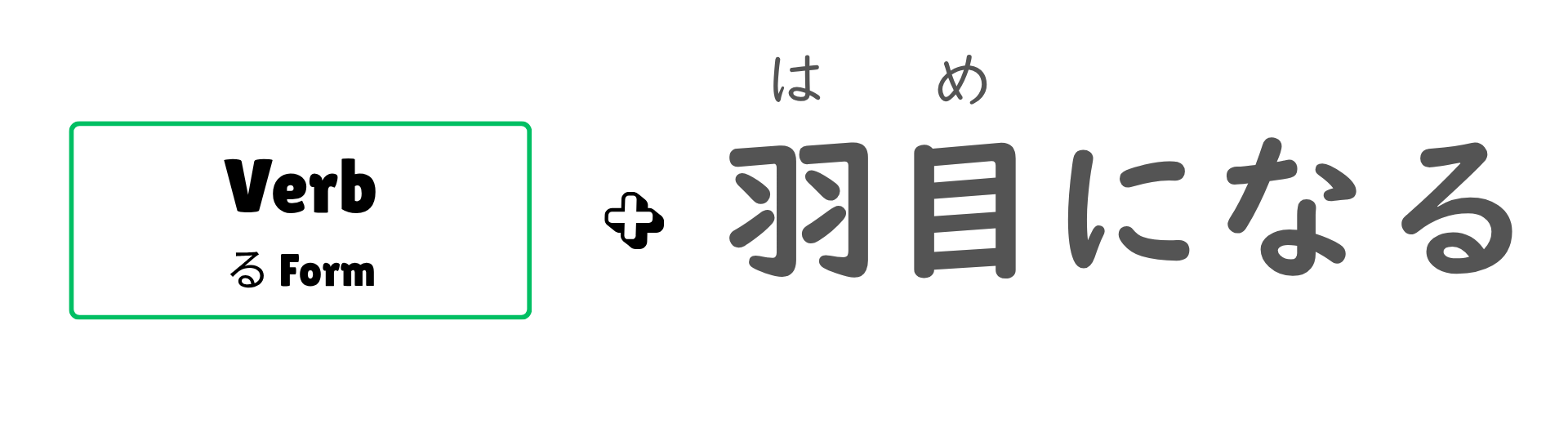

ことになる (koto ni naru) vs ざるを得ない (zaru wo enai) vs 羽目になる (hame ni naru)
All three expressions describe an outcome or result, but the speaker’s attitude and emotional involvement are very different.
ことになる (koto ni naru)
This is a neutral expression. It simply states a decision or outcome, without implying that it is good or bad.
来月、日本へ出張することになりました。
らいげつ、にほん へ しゅっちょう する こと に なりました。
raigetsu, nihon e shucchou suru koto ni narimashita.
It has been decided that I will go on a business trip to Japan next month.
ざるを得ない (zaru wo enai)
ざるを得ない means “have no choice but to”.
It emphasizes that the speaker understands the situation logically and accepts it, even if it is not ideal.
This expression is formal and objective, and it is often used in writing, news, or serious explanations.
チームメイトが急病ということであれば、私が出張せざるを得ないですね。
ちーむめいと が きゅうびょう という こと で あれば、わたし が しゅっちょう せざる を えない です ね。
chiimu meito ga kyuubyou to iu koto de areba, watashi ga shucchou sezaru wo enai desu ne.
If my teammate is suddenly ill, I guess I have no choice but to go on the business trip.
羽目になる (hame ni naru)
羽目になる is used only for negative, inconvenient, or embarrassing outcomes. It clearly shows frustration, annoyance, or reluctance.
上司の気まぐれな決定で、週末に出張する羽目になった。
じょうし の きまぐれ な けってい で、しゅうまつ に しゅっちょう する はめ に なった。
joushi no kimagure na kettei de, shuumatsu ni shucchou suru hame ni natta.
Because of my boss’s whimsical decision, I ended up having to go on a business trip over the weekend.
💡 Quick Tip
ことになる (koto ni naru) - neutral outcome or decision
ざるを得ない (zaru wo enai) - logical necessity, no choice, formal
羽目になる (hame ni naru) - unwanted result, frustration, bad luck

終電に乗らないと、雨の中を1時間も歩いて帰る羽目になる。
しゅうでん に のらない と、あめ の なか を いちじかん も あるいて かえる はめ に なる。
shuuden ni noranai to, ame no naka wo ichijikan mo aruite kaeru hame ni naru.
If I don’t catch the last train, I’ll end up walking home for an hour in the rain.
雪で飛行機が欠航し、空港で一晩過ごす羽目になった。
ゆき で ひこうき が けっこう し、くうこう で ひとばん すごす はめ に なった。
yuki de hikouki ga kekkou shi, kuukou de hitoban sugosu hame ni natta.
The flight was canceled due to snow, and I ended up spending the night at the airport.
海外保険に加入しておかないと、高額な医療費を払う羽目になるよ。
かいがい ほけん に かにゅう して おかない と、こうがく な いりょうひ を はらう はめ に なる よ。
kaigai hoken ni kanyuu shite okanai to, kougaku na iryouhi wo harau hame ni naru yo.
If you don’t get overseas insurance, you’ll end up having to pay expensive medical bills.
二人の喧嘩に巻き込まれ、私が仲裁する羽目になった。
ふたり の けんか に まきこまれ、わたし が ちゅうさい する はめ に なった。
futari no kenka ni makikomare, watashi ga chuusai suru hame ni natta.
I got caught in their fight and ended up having to mediate.
真夜中の衝動買いのせいで、今月は節約する羽目になった。
まよなか の しょうどうがい の せい で、こんげつ は せつやく する はめ に なった。
mayonaka no shoudougai no sei de, kongetsu wa setsuyaku suru hame ni natta.
Because of a late-night impulse buy, I ended up having to save money this month.
料理を焦がしてしまい、結局ピザを頼む羽目になった。
りょうり を こがして しまい、けっきょく ぴざ を たのむ はめ に なった。
ryouri wo kogashite shimai, kekkyoku piza wo tanomu hame ni natta.
I burned the food and ended up ordering pizza in the end.

- Grammar Point: 羽目になる (はめになる / hame ni naru)
- JLPT Level: N1
- Meaning: To end up with, to get stuck with (an unpleasant situation)
- Quick Explanation: Use 羽目になる when events turn against your will and force you into a troublesome, costly, or embarrassing situation. It emphasizes that the outcome was unwanted and caused by circumstances.
So that’s how we use 羽目になる!
It’s a very human expression, because let’s be honest, things don’t always go the way we plan.
When something goes wrong and you want to talk about an outcome you really did not want, 羽目になる is perfect for telling that story in natural, expressive Japanese.
試験対策は計画をしっかり立てて取り組もう。そうしないと、直前に後悔する羽目になるよ!
しけん たいさく は けいかく を しっかり たてて とりくもう。そう しない と、ちょくぜん に こうかい する はめ に なる よ!
shiken taisaku wa keikaku wo shikkari tatete torikumou. sou shinai to, chokuzen ni koukai suru hame ni naru yo!
Make a solid study plan for your exams. Otherwise, you will end up regretting it at the last minute!
Now it’s your turn!
Try making your own sentence with 羽目になる and turn a bit of bad luck into great Japanese practice.
Your Sensei,
Hikari 👩🏻🏫✨
Get Hikari's JLPT Mock Exams & Preparation Lessons!
Whether you are studying to pass the JLPT or looking for a challenge in your learning journey, these courses are perfect for you!
Join my ニュースレター Newsletter 📩
You can expect an email from me once a week about Japanese culture.
Don't worry, your information will not be shared.
We hate SPAM. We will never sell your information, for any reason.